Author: bravegirlwannabe

  • Brave Girls Need Help With Faith, Too

    I hate cancer.

    I really, really hate cancer so much. Today I read that someone I don’t even know received a breast cancer diagnosis, and it hit me like a ton of bricks. And there’s no real reason why, because it doesn’t impact me personally at all. I don’t know how to explain it except to say that I feel sad.

    I just feel sad – maybe that’s for me and maybe that’s for her family, who I also don’t know at all. Their situation is not about me at all, and yet I can’t seem to rein in my feelings about it. Their situation conjures up this fuzzy memory I have of what it’s like to be processing that word for the first time when it’s in relation to someone you love. It’s like you’re underwater but floating and stationary, and you can see people above you talking to you and giving you guidance about coming up, and you look around and can see other people swimming around you pointing to the people above to ensure you listen carefully to the people talking, but all you really process is that one word in your head over and over and over again. Cancer. And you wonder why everyone around you continues to talk and point because nothing matters in the same way anymore.

    It seems like yesterday, and yet it seems like another lifetime. Almost like it happened to a whole other person sometimes. And maybe that’s really a truth and that it was a whole other person, because the me before Audrey and the me after Audrey are kind-of two different mes.

    In 2011, I was 8 months into a healthy pregnancy with my second child. Like most Moms, I was the biggest I have ever felt and I have ever been, and I was convinced that I might be having the Guinness Book of World Records most giant baby ever. So I went to a regularly scheduled appointment and convinced a young girl who was filling in for my real doctor to do an ultrasound and see how big she was going to be, with secret hopes that we could induce early and I could just not have to be pregnant anymore. And what that ultrasound showed was two things. First, Audrey was going to be over 10 pounds. And second, she had a tumor in her abdomen. And while many doctors couldn’t initially agree on what exactly was happening, the one certainty on which they all agreed is that she would be born with cancer.

    Audrey’s birthday is on June 21 – the longest day of the year. She was a cuddler and she was hot-headed and some of her hair stuck straight up like Alfalfa and she was just comically bigger than all of the other babies in the NICU. And it was a really good thing she was so big because she was better able to deal with and recover from the major abdominal surgery that was to come on day 6 of her life. Finding out my child had cancer really threw me off balance, and so in those early days I stoically put on and held on to control-Beth, who I know from experience can manage in a crisis. I developed one plan after another and made bulleted lists of to-dos for each one.

    Here’s what will happen: We’ll get a test result that she’s been miraculously healed.

    Nope.

    OK, next plan: the cancer will be in one tumor in one area, so we’ll get it out quickly and this will all be over in a few weeks.

    No again.

    During the surgery we learned that the cancer that was supposed to be removable was not contained – and not only that, it had spread to her lymph nodes and was manifesting in skin nodules we couldn’t even see or feel. And basically what that meant is that we weren’t going to be able to get it all out no matter what we did. Time for plan 3.

    As Audrey recovered from that surgery over weeks and months, she had a series of radioactive injections and full body scans that showed us where the cancer cells were active in her body. And for someone who likes a plan, I thought those scans showed me exactly what I needed to be focused on. And I started to focus all my energy on research and trials and hospitals with the best cure rates. I read journal after journal and test summary after test summary and trial summary after trial summary. I joined online groups to compare research with other parents all over the world, and to just read their opinions about everything.

    I focused all my energy into information, because information made me feel in control. And with information I could build and stick to a plan. But you know what the research showed? That Audrey had the right number of chromosomes and she didn’t have the super aggressive cells and the tumor make-up fit the type of some cases where the cancer could eventually go away. And so her doctors suggested something that was almost as scary as chemo. They suggested that we do nothing for a while – that we watch and wait and see what happened.

    And that went against every instinct I had. That did not seem like a plan at all. And in fact, that was maybe a plan for really dumb people. I just wanted the bad stuff out and gone, and how hard could it be really, because we knew where it was and we could see where it was. The whole thing was so frustrating. I didn’t want her to have cancer at all, and I didn’t want her to have to have chemo, and yet I didn’t want to just sit around and do nothing.

    And you know what was in an equal state of shambles and frustration? My relationship with God. While I’d like to say that I was a person filled with faith in those early months, the truth is I was not. I did not want to leave the life of my child to chance or fate or faith or anything that did not have firm statistical odds.

    During that time, I stopped going to church. I didn’t stop praying and talking to God, and in fact I talked to Him all the time – but I did stop worshipping. The one thing I did do in church that year was have Audrey baptized. And I actually really struggled with my motives for doing that. Ultimately I did it because I still believed in God, but the truth is I also did it because I had become very superstitious. I wanted to cover her with some sort of protection shield – I was clinging to hope that if I had her dedicated, that baptism would provide a protection, which meant that nothing really bad could happen to her and that she wouldn’t die. And even as I had those thoughts, logical me knew that people much more faithful than I had sicker children. People much more faithful than I had lost a child.

    And then I started to think about all kinds of people – people with no faith at all, and people who had the “wrong” God, people whose children got a horrible diagnosis but they were healed – and people who had healthy children who were never even sick! And I started to wonder who did something right and who did something wrong? Why were some people’s children healed and some not? Was it luck? Was it something the parents did or did not do? I was frustrated trying to figure it all out.

    I mean, I was a pretty good pregnant person – I didn’t eat junk all day, I didn’t smoke, etc. Yet people who treated their bodies horribly were having healthy children while Audrey was in the NICU with tubes and wires. People who didn’t even want children were having healthy children. So what the hell happened?

    And what caused this? Did I party too much in college? Perhaps I was being punished for that. Was it the cheese I ate, the water I drank from the tap, the chemicals in my lawn?

    Or here’s the really scary stuff. I have been a Christian my entire life. Not that anyone deserves a cancer diagnosis, but I felt angry – like “really, THIS is what I get?” Aren’t I owed something a little better than that? And when I wasn’t feeling so outraged I felt ashamed of that anger, like a bad child. I wondered if maybe I was not really as good of a Christian as I thought. Did I not have enough faith to please God? Was God disappointed in me? And if so, was THIS the punishment? Was my child having cancer my punishment?

    The answer, of course, is no. The answer is pretty simple. We live in an imperfect world, and sometimes really crappy things happen. It just is. Some people lose their children and some people don’t. Some people have children with medical issues and some don’t. We all experience the unexpected bad stuff and we have to find the good when it happens and we have to find the lessons when it happens. It’s our job – and it’s our blessing – when we find the gift in the bad things that happen in our lives.

    For 377 days, from the time of Audrey’s birth to the time she was declared No Evidence of Disease, I rode a roller coaster. (If you know me at all, you know I absolutely detest roller coasters.) Some of those days were long and slow climbs as we waited for weekly or monthly test results. Some of those days were fast and thrilling days as we got news that Audrey was stable or she’d hit some milestone that was good. Some of those days it felt like the roller coaster broke down mid-ride as we got unexpected test results.

    For 377 days I tried really hard to lean on God more and lean on statistical facts and my feelings less.

    For 377 days, I wanted so badly to hear she was healed.

    For 377 days, I worked to let go of my attachment to my life plan and the life plan I had for Audrey.

    For 377 days, I proclaimed out loud at least a dozen times a day and sometimes maybe a hundred times a day “I thank you Father that Audrey Grace is cancer-free.” Or “Audrey Grace is cancer-free.” I was going to speak it into existence.

    I’d like to say I handled that year of uncertainty and waiting with grace and patience and trust. But the truth is I combined my praying and my out-loud-claimings and my faith with doctor recommendations and the consumption of thousands of pages of opinions and data that made me feel like I could have faith.

    I am soooooo flawed. And maybe the truth is that hearing the word cancer just reminds me of how little faith I did have, and it makes me ashamed. And angry at myself.  Maybe that’s why a stranger’s diagnosis brings me down.

    One thing I *can* say is that I learned something important as a result of that roller coaster ride. I learned a lot more about who God is. He is a healer. Sometimes He heals through a miraculous event and sometimes He does it through medicine and doctors (and sometimes He does it in the next life).

    And you know what else? God made me a Type A planner. He knows exactly who I am, and I don’t think any of my questions or frustrations or doubts or even my spreadsheets! surprised Him or disappointed Him. He’s a parent just like I’m a parent. He loves me anyway, just like I love my girls anyway.

    Ella: Do you remember the name of the kind of cancer you had?

    Audrey: neuro-something

    Ella: neuroblastoma

    Audrey: Yeah, Dr. Owen fixed it.

    Ella: Yes, he did.

    Audrey: You know what? Actually, God fixed it.

    Ella: God fixed it through Dr. Owen.

    I hate cancer. And cancer makes me so angry and cancer makes me so sad. And yet, I smile when I think of the story of a brave little girl with a very big scar. I smile when I think of the faith and understanding that already dwell within that brave little girl with the very big scar.
  • So, are you excited to go back to school?!

    If I could remove one line from every single person’s list of things they say to kids, it would be this: So, are you excited to go back to school?!

    Because let’s face it – most kids are not. Even the kids that are really good at school and who love education aren’t sitting around thinking ‘Gosh, I can’t wait to stop sleeping in and eat mediocre cafeteria food midday then go home and do homework for 2 hours.’

    School only seems exciting to people who are no longer in school – real adults. Young adults early in their career miss the freedom of college schedules. Somewhat young adults who are now parents love school because even though they don’t want to suffer through their kids’ homework for 10 months of the year, they love the structure and schedule that the school day brings for the entire household. Not-so-young adults look back on school fondly as the good old days – the heyday time when they played sports and secured the county/district championship, before responsibility then bills then diapers then AARP.

    But the real reason I want to remove this line from every person’s kid-friendly repertoire is because for many kids, school and all thoughts related to school are an absolute nightmare. That might be for a dozen different reasons – because they are bullied, because they have a learning disability, because they are an introvert, or because their parents put too much pressure on them.

    I have two children who both do well in school, as measured by grades and not pulling fire alarms. One of those children is an extrovert who can’t wait to see all her friends and start using an overly complicated calculator. This is the child you all imagine when you ask, “So, are you excited to go back to school?!”

    My other child is frightened of all the coming change – new teacher, new kids, new room, new noises, new crowds. She’s spent the summer surrounded by family and church family and friends and in a cocoon of consistency, and she loves that. She thrives in that cocoon. And probably a solid 4 weeks ago she began internally dreading the first day of school. It has disrupted her sleep and her thoughts, and made her edgy.

    The real-real reason I want to remove this line from every person’s kid-friendly repertoire is because some kids are anxious about school. And one of those kids is my daughter. And every time a smiling adult with the absolute best of intentions asks her if she’s excited about going back to school, they have no idea of the tidal wave of feelings they’ve set off.

    And all the things I’ve desperately done to make her life and her days the absolute best they can be are just washed away in that tidal wave of unsettledness. I’ve read dozens and dozens of articles about how to make it better. I’ve tried everything I can think of to make it better. We draw. We stay busy. We make crafts. We read. We pick out clothes. We buy light-up shoes. We choose folders and post-its. We hate those colors and we return them and pick different ones. We meet the teacher. We find the room. We drive the bus route. We prepare lunch menus. We buy our favorite pudding cups and fruit cups. We pray. We even talk about how to be brave.

    Those things sometimes help momentarily, but they are no panacea. And part of me wants the last 24 hours of summer to last forever, while the other part is hoping to wake up and find it’s next weekend and we’ve all already survived the first week. But that’s not very brave, and it’s my job to set the brave example.

    And so I ended today with a list of modified questions to try to get her to refocus her anxious thoughts about school: Of the kids you know in your class, who is the funniest? If you get to pick what the art teacher focuses on first, will you choose clay or paint? Which teacher are you most excited to see and hug when you walk in on the first day? Let’s make a bet – will the first pizza day be cheese or pepperoni?

    In the coming couple of weeks when you see other children, or your grandchildren, or your nieces or nephews, or kids at church or in your neighborhood, please do lean in and talk to them. Show them you love them and give them a hug and ask questions that confirm for them that you are interested in their life. But instead of ‘how was your first week of school?’ you might consider asking who was the most fun to play with this week or what was their favorite part of this week or what is the most exciting thing they are learning about right now.

    Nelson Mandela said, “I learned that courage was not the absence of fear, but the triumph over it. The brave man is not he who does not feel afraid, but he who conquers that fear.”

    There are a lot of little ones out there looking to us – the big ones – to show them how to be brave. And showing kids how to be brave is more than just telling them you have to face your fears or pointing to helpers that wear uniforms and save lives. Part of showing kids how to be brave is simply helping them focus on positives.

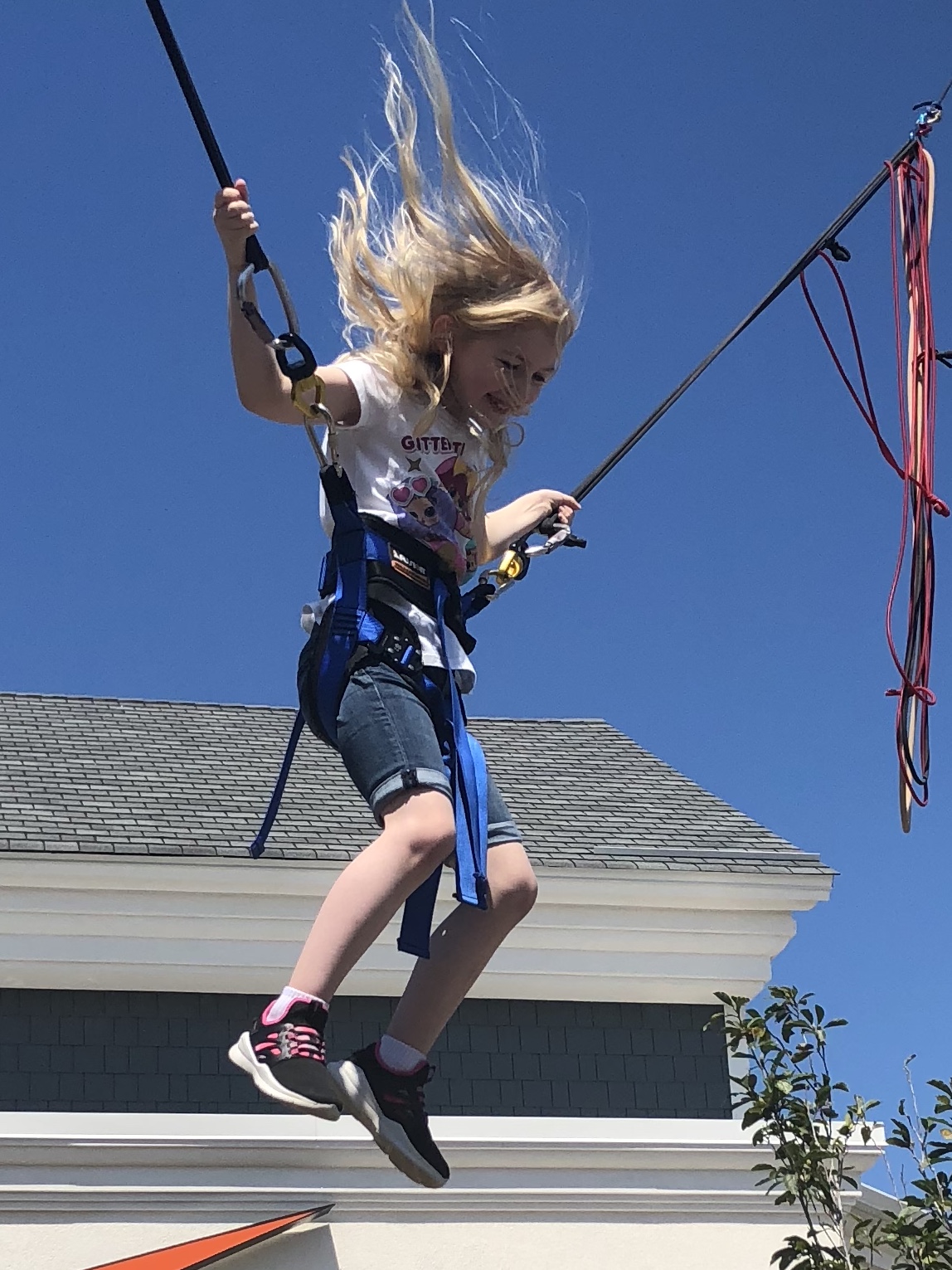
    If anyone in the 757 sees us in the coming few days and asks my daughter what was the best thing about this week, she is likely not going to mention school. My guess is she will say the bungee trampoline. I thought this would be a chance for her to be brave, but as it turns out she couldn’t wait and she loved it and she squealed with delight – and the whole ordeal was actually a chance for me to be brave, because when I saw how high the jumping got it took everything I had not to tackle the way-too-laid-back-in-superhip-overpriced-sunglasses-man that was running this thing and demand he get her down right that instant.

    IMG_E5311

  • Brave Girl Stories, in Pictures

    I love photographs. Color photos. Black and white photos. Sepia photos. Panoramic photos. School photos. Nature photos. War photos. Historical event photos.

    Not only do I take a ton of pictures thanks to the convenience of my iPhone, I have tons of old photos in boxes and frames around my house. And a few times a year I still have prints made, and I meticulously put pictures of the girls and our family into albums for each of them so that at some point they can browse through their childhood memories (in order, courtesy of OCD).

    I love anyone’s and everyone’s old photos. I will look at them repeatedly and notice tiny details and reason in my head about what led up to the photo, what followed the photo, and what environment surrounds the photo. Photos tell stories, and I guess more than anything, when you boil it down, I am actually in love with the history and the stories that photos document.

    In the last few months I’ve felt awkward about photographs. I want to continue to document the girls’ childhood memories and not have a big gap in their lives and in their books, but documenting a part of their life that includes sadness and grief feels…not wrong, necessarily, but also not right. And yet everyone’s life includes periods of sadness and grief, so why does it feel odd? Is it wrong to show us vulnerable? It’s not wrong to show myself vulnerable, but it does feel wrong to reveal their vulnerability and their down moments. So is the answer then to only show the pictures of the phases of our life that are fantastic? That’s also wrong. Not only is that what we all see all the time – everyone’s day  boiled down to an adorable “your story” on Facebook and Instagram – it’s not the truth.

    And yet at the same time, I feel like it’s wrong when I do post some of our daily happy pictures. We are actually laughing and having fun when we’re at bowling alleys and trampoline parks and farms and our driveway, but if I show us having fun will people think we’re fine – that we’ve moved on and life is great and we’re past our little speed bump? That life is back to fantastic? Back to blessed? That’s not the truth, either.

    And then…the big what if. What if happy pictures lead people to believe that what happened wasn’t really a big deal because we’re able to have fun so quickly – and if so, does that mean that what happened to our family wasn’t really all that bad?

    That thought makes me angry. Just because we make decisions to find positives and to find some happy and to experience some joy – and make no mistake, those are DECISIONS we make – does not in any way make a statement as to the severity of the actions of others who hurt my girls. They persevere despite those actions. They persist despite those actions. They keep moving despite those actions.

    But I digress. The point, I guess, is that I think of pictures differently now. Maybe I overthink pictures. I desperately want Ella and Audrey to look back at this time and not just think about the fact that our family changed. I want them to look back and be able to see how courageous they were. See how far they’ve come. See that they could always count on me. See that I was strong.

    I think they’ll be able to see some of that. But I think they may also look back on a photo and think ‘that’s the picture where we were feeding a piglet, but earlier that day Mom really shouted at Dad.’ That’s what I think when I look at some of the photos, so I have to assume they will, too. And that makes me sad. And yet, it is truth.

    I keep mulling over this snippet from The Blindfold by Siri Hustvedt.

    ‘You really believe that there are subjects that shouldn’t be photographed?’ George said. He spoke evenly and softly.
    ‘Maybe I do,’ I said, thinking aloud.
    ‘You believe in censorship then,’ said Stephen.
    I looked up at Stephen. His face was tight, combative. ‘Not censorship,’ I said slowly. ‘That’s external. I mean control from the inside. After all, pictures can lie, too, can convey falseness rather than truth.’

    We need to tell more of the stories behind our photos, so that we are all a little more real with each other. Here’s our story in three photos from this weekend, and it’s really the story of the stages of girl vanity.

    Audrey is in disguise in her picture. Basically, I think the young just don’t care what they look like in photos. Audrey wants to try every snapchat filter every day. I also regularly find pictures she’s taken to try to see up her own nose or in her own ear, or where she’s trying to see how big she can make her teeth appear. The young either find all photos of themselves awesome in some way or they don’t think twice about the photo after they realize they cannot see up their nose into their brain.

    Girls in the middle of growing up care a lot about photos. Ella takes photos of herself all the time and although it doesn’t seem possible, I think she discards more photos than she keeps. Middle School social media is somewhat confusing, but I think it can be summed up like this: girls like all the photos posted by all other girls at their school, but then hop onto House Party with just the girls they actually like to talk about the photos they just “liked” posted by girls they may or may not like whose photos they didn’t really like. Got that? I mean, it’s so simple really.

    And then there’s the old: me. Instead of “old,” maybe we’ll just characterize that group as women over 40. When we end up with a picture where only *some* of our wrinkles show, especially at a time we’re trying to grow our hair out, we call that a win.

    AGGI0322

  • Be Blessed (or Blessed Be), Brave Girl

    My children are smarter than me.

    I say this regularly and I think people think I am being silly. It’s true and I’ll say it again: my girls are smarter than me. I may still need to provide them with instruction and guidance as it relates to riding a bike, driving a car, eating broccoli, and setting boundaries on dates, but they are solid on some of the heavy fundamentals in ways that I am not.

    Audrey has been playing this new game on her ipad. You choose a song and you’re only allowed to hit certain piano keys and if you hit the wrong key, you’re out and have to start again. Tonight she was trying very hard to master a song and getting frustrated that she couldn’t do it. I thought I might distract her for a bit, and our conversation went like this.

    me: Walk away from it for a few minutes and then try again later.

    Audrey: No.

    me: What song is that?

    Audrey: Thanks to God or Blessed by God or something.

    me: Why’d you choose that song?

    Audrey: Because it reminds me of church. I like church music.

    me: Who do you think is blessed?

    Audrey: Us.

    me: Why do you think we’re blessed?

    Audrey: Because God loves us.

    At age 7, Audrey understands a truth that I often overlook. We are blessed because God loves us. I am blessed and Ella is blessed and Audrey is blessed.

    It hasn’t felt like we’re blessed in quite some time. Things are better – life is not so chaotic, we’re not crying every day, we go out and have fun and enjoy friends. In fact, we laugh every day and we smile every day and we play every day. But blessed? That’s for people who have an awesome life and who love their life and who don’t have problems. That’s for people with intact families where Mom and Dad live in one house together with the children, and they eat meals together and play games together and plan vacations together.

    But the truth is we were living that “blessing” one year ago and it was a lie. We looked like we were living that blessing and 3 of us thought we were living that blessing, but that wasn’t the truth – even if we didn’t know it.

    When I think about the periods of my life where I felt blessed and I said things like “I’m so blessed” or “we’re so blessed,” it’s almost always been after a particularly challenging period. So in truth, whether or not I actively thought about it, deep down I believed that blessed means better than.

    I was not blessed to discover that Audrey had cancer. However, when I met other parents who had a child with a higher stage or a worse prognosis, I suddenly felt blessed.

    I was not blessed to discover that my marriage was a complete sham. However, as I’ve heard stories of people’s kids taken away and bank accounts being frozen and fights over houses, my breakup really wasn’t all that bad. And suddenly I again felt blessed.

    But that’s not blessed. That’s better than. That’s ‘my situation isn’t as bad as yours, so I must be blessed and thankful.’

    Who do you think is blessed? Us, Audrey said. US. And I can’t quite embrace it. I really want to say, “Really? Us? You think?” Of course, I won’t say that but I am still thinking about it, and so I’m writing it down. I am writing it down because I am still so startled by the simplicity of her follow-up: because God loves us.

    Blessed is what I am no matter what my situation or environment. Blessed is what I am because God loves me.

    I know this is true. And yet, the truth is I am skeptical and I have mixed feelings about it. And maybe that makes me a bad Christian. I hope not, and now I have to worry about that, too. (There’s no end to the things I will allow myself to obsess over.)

    Are we blessed? I know we are, and in many ways. But it doesn’t always feel like it. And it doesn’t always feel like it because I’m applying the “better than” rules. And I think it doesn’t really matter whether or not it feels like it – feelings don’t really matter in this blessing discussion. We are loved whether or not we feel it. God loves us even if we forget it sometimes. And that love isn’t dependent on how we’ve behaved or what’s happened in our lives. It is.

    Today, a serious 7-year-old reminded a skeptical and silly 45-year-old of a very simple truth: blessed is what we are because God loves us.

    Blessed be (the fruit loops).

    IMG_E5132

  • Why don’t we say Partly Sunny?

    The word broken means a lot more than I thought it did.

    I’ve always thought of broken as not working and not fixable. Like a mirror – once it’s broken, it’s done. Nothing but an annoying thing you need to clean up (as you’re trying not to cut yourself) and throw away.

    But according to dictionary.com, broken actually has a lot of definitions.

    • fragmented
    • fractured
    • torn
    • (of sky cover) being more than half, but not totally, covered by clouds
    • changing direction abruptly
    • incomplete
    • interrupted
    • disrupted
    • disconnected
    • weakened in strength, spirit
    • not smooth

    These definitions make me think differently about broken. Broken isn’t always a mirror that will never be used again. Sometimes it’s a toy that a child thinks will never work again, when really that toy just needs new batteries. Sometimes it’s a cell phone that just needs a little time to rest and dry out in rice. Sometimes it’s a leg that needs to be in a cast while it heals. Sometimes it’s an egg that’s a necessary ingredient for a cake.

    Broken is not the end.

    Broken is when your life changes direction abruptly.

    Broken is how you might describe the flow of things when your life is interrupted.

    Broken is fragmented thoughts and feelings you struggle to pull together, because you’re disconnected from who and/or what you used to be.

    Broken is when life isn’t smooth.

    Broken is not the end.

    I keep coming back to the sky cover reference for broken: “being more than half, but not totally, covered by clouds.” That’s what life has been like for a little while now. The dark and angry storm clouds have cleared out and we’re in a weather pattern that is party cloudy – or perhaps partly sunny is the better way to look at it. (Why the heck don’t we say partly sunny?)

    Days are filled with normal things like camp and dinner time and play and work and tickling and fart jokes and board games. Days are filled with happy moments. But here and there, our days have moments of sadness or anger or melancholy. Sometimes our days have many of those moments. Because things that used to function how we liked don’t function that way anymore. Because we face situations and people that challenge us. Because some of the pictures that used to hang in our house don’t hang here anymore, because some of the people that used to live here don’t live here anymore.

    I love to take pictures. I so love pictures that I still have hundreds of 4 by 6’s printed each year and I meticulously place them in order in old-fashioned tangible photo albums for each of the girls. Pictures tell our story. Pictures help us to remember events and moments.

    But when we share pictures online, we are telling a fragmented story – a broken story. And that’s because we tend to share only the pictures that show us happy and having fun. In part, we tell happy stories with our pictures because no one thinks to take pictures when they’re crying. And no one gets pictures of their family all shouting at one another as they try to figure out whose fault it really was that someone dropped the container of eggs. We often literally have no unhappy pictures. And frankly, no one really wants to see those pictures.

    But we should see those not-so-perfect pictures, because that is real life.

    Real life has brokenness. Every single one of us has days and lives filled with fragments of loving, smiley, happy, sad, angry, shouty, and cut-off-that-guy-in-traffic moments.

    The girls and I love to play with Snapchat filters. If an alien 7 light years away finds our family photos 300 years from now, they are going to wonder what the heck kind of creatures we really were. One of their current filters is called Broken Mirror, which just struck me yesterday as the most “real” thing that I’ve ever seen on social media – showing ourselves fragmented. Showing ourselves broken.

    My life has brokenness, and that’s OK.

    That’s OK because broken is fixable.

    And sometimes things that are broken end up contributing to a really awesome cake.