Tag: balance

  • Self Care and *Real* People

    Self Care and *Real* People

    I don’t think I can scroll through social media for more than two minutes without seeing some sort of post about self care. Sometimes I read things like Be patient with yourself and I roll my eyes, and other times I see You are allowed to eat three donuts and I feel like nobody gets me like that person gets me.

    Self care has twenty million posts on Instagram. Twenty million posts to encourage people that they are worthy. Worthy of rest or happiness or love or attention or respect or health. What does it say about our world that so many people need a reminder that they are worthy? What does it say about me that I sometimes need that reminder?

    I know that self care is about wellness, and that there are millions of people out there that need real help and a real plan to care for themselves properly. Self care is critically important for them. My experience with the term self care is in a more buzzword kind of way – like a special password that tells me someone is going to spend time in a way that makes them feel good. A pedicure. A round of golf. A bubble bath.

    Those are all nice things but it seems like we should be striving to live lives where we don’t get to the point of needing a fix of some sort for a few hours. Self care in that buzzword-scenario seems like filling potholes instead of figuring out how to make better roads. Shouldn’t we practice self care proactively, as a lifestyle, instead of occasionally fitting it in after a build-up of seemingly overwhelming things?

    It comes down to three things, I think:

    • shedding Mom guilt
    • balance
    • getting real people in our village

    And actually, I think maybe the number one thing we can do to practice self care is in that third bullet – it’s in surrounding ourselves with people who love us enough to be real with us and tell us the truth. If we treat others like we want to be treated, live lives we can be proud of, and live in a balanced, healthy way mentally and physically and spiritually we should not need pothole-type-self care. But because we’re not perfect and we make mistakes and sometimes we stray onto paths that aren’t the best for us, it’s critically important that we have people around us who will not accept our bullshit and who will call us out on our bullshit.

    We need balance and truth in our lives in order for self care to really be a way of life.
    We tend to hide our dysfunction. Simply, we don’t want to be embarrassed or ashamed. But it’s in our moments and situations of dysfunction that it’s absolutely critical that the people around us be people we have chosen carefully and purposefully – that they be those people who we knew would be able to say to us that’s such BS, or you’re lying to yourself, or you need to take care of yourself, or that’s not right, or you’re hurting yourself/others. And on top of that, dysfunction, if it must be or is revealed, will then seek other dysfunction instead of truth – above all else because it craves approval and it craves cohorts. Dysfunction wants others to say with their words or behavior that what’s happening is OK.

    Healthy people – our purposefully chosen village around us who practice actual love – will call out our dysfunction. It’s other dysfunction that tells us our bad path or our poor choices or our hiding is OK. Healthy encourages focus, while dysfunction encourages distraction. Healthy encourages responsibility, while dysfunction encourages avoidance. Healthy encourages help, while dysfunction encourages further isolation.

    In my circles right now, self care is mostly a password that allows moms to take a small amount of time “off” from focusing on our children, which is how we spend the vast majority of our time, and instead spend an hour on a pedicure or taking a Sunday afternoon nap. It’s the occasional prescription for a life filled with busy-ness.

    My life is filled with busy-ness, and I actually like that the vast majority of the time. Also, it’s necessary right now. This is a period in my life where I’m a working Mom of two children who are at stages where they can get themselves a simple meal but they can’t yet drive. Where they need an engaged Momma to make sure they are on the right path each day, and to make sure that their hormones aren’t an excuse for not practicing kindness, and that they get up and appropriately dressed and out of the house on time, that they don’t blow up the microwave, that they get to appointments and gymnastics and swim and chorus and youth group and play dates and football games.

    I also want the girls to look back on their childhoods and remember that their Mom didn’t just have guidelines and rules, but that she played – that she splashed in the ocean even though we all had regular clothes on, that she let them put crazy makeup all over her face, and that she sang Lizzo when the car windows were rolled down.

    This is a relatively short period of my overall life and I have to use this time so wisely. I realized this week that in this time the girls need to also see me model balance and self care. They need to learn it as a way of life and they’ll do that in part by watching me. It’s not enough to get pedicures together, which we just all like to do. We have to talk about the importance of down time, we have to take afternoons to rest together, we have to practice gratitude together, we have to help each other choose our village carefully, and we have to talk openly about when we’re overwhelmed. We have to bravely and purposefully be real with others, and bravely and purposefully surround ourselves with people who will be real with us.
  • Balance

    Balance

    I learned a new word recently: Koyaanisqatsi. It’s pronounced coy-e-on-e-skat-see and it’s a Hopi word that means out of balance.

    When you really boil it down the word Hopi stands for peace, and the Hopi are known as the peaceful people. Long before the first Europeans landed on our shores and became Americans, and long before the first group of men and women charged across a mostly untouched land to establish homesteads or search for gold, the Hopi lived in America.

    I love and appreciate this country and I love the people in it. I love and appreciate and am thankful for the men and women who have fought in various wars and conflicts over hundreds of years to ensure that my daughters and I can live and worship freely here today. But when I think about the founding of our nation by people committed to a better way of life versus the people of today, I think we have become a people and a nation out of balance.

    What was once a nation that welcomed newcomers seeking safety or opportunity or more freedom is now a nation arguing about walls to keep people out. Koyaanisqatsi.

    What was once a nation of communities that stuck together and made sure all of its families were fed and clothed and tended when sick is now largely a nation of individual people who keep to themselves. A nation arguing over what requirements need to be met for a person to deserve food or shelter or medicine. Koyaanisqatsi.

    As much as we get mad about and write books about millennials and their focus on self, it feels to me like we have become a nation of individuals who are way too entitled. We wax poetic about how little we had when we were young, maybe how our great-grandparents or our parents had to struggle for food or things or college or work, but now it seems no amount of struggle in another is enough to warrant help for that person. I guess we feel we have somehow done something to deserve the good life we have but that others haven’t done enough or aren’t lucky enough. Instead of helping others, which was the necessary way of life when this country was founded, we say we feel sorry for people and we hold out hope for them and we’ll pray for them. And while praying is the absolute right thing for us to do, we must do much, much more.

    What good is it, my brothers and sisters, if someone claims to have faith but has no deeds? Can such faith save them? Suppose a brother or a sister is without clothes and daily food. If one of you says to them, “Go in peace; keep warm and well fed,” but does nothing about their physical needs, what good is it? In the same way, faith by itself, if it is not accompanied by action, is dead. ~ James 2: 14-17.

    I am a Christian, and I am so seriously completely one hundred percent over my people saying we’re praying about something while doing nothing. Those are not the instructions of the God we follow. And not only are we skipping the step of action to help people, in many cases we are complicit in the creation of the situations of people who need help.

    We don’t want all people to have access to the same health care, but we pray for people who are sick. We don’t want to regulate the right to bear arms, but we pray for the victims in mass shootings. We shame women for even considering abortion and then we shame women for needing help once their babies are born.

    Koyaanisqatsi. Koyaanisqatsi. Koyaanisqatsi.

    Our life in America – and there are dozens of kinds of American life depending on your age, race, gender, and access to money – is certainly a good one in comparison to many other countries. We are “better than” in a number of categories when stacked against our peers, but is being good in comparison enough? It’s a question for our country and it’s a question for each one of us as individuals. Just because I haven’t murdered anybody doesn’t make me a good human – it simply, maybe, makes me “better than” someone who has taken the life of another. Just because America provides more freedom than North Korea doesn’t make us a great nation – it simply makes us “better than” a dictatorship.

    I think we are called to be and do much more. That our privilege comes with more hard work and responsibility, not more entitlement. It’s our job to show others what we can do, not look the other way. It’s our job to help all the people we can, not just all the people who can do something for us in return.

    If we expect to continue to live in privilege, we need to live up to the great responsibility given us. We can’t expect to reap a prosperous life or nation when the seeds we are sowing are in things like adding to the debt of our young people, allowing medical bills to force families to declare bankruptcy, treating physical wounds but not wounds of the psyche, or in treating suburban house pets better than children. I don’t think we can expect to continue to live in privilege if we encourage fear of or hatred of people who don’t look like us. I don’t think we can expect to live in privilege if we continue to live out of balance. I don’t think we can expect to live in peace if we continue to live out of balance – each in our homes or in our nation.

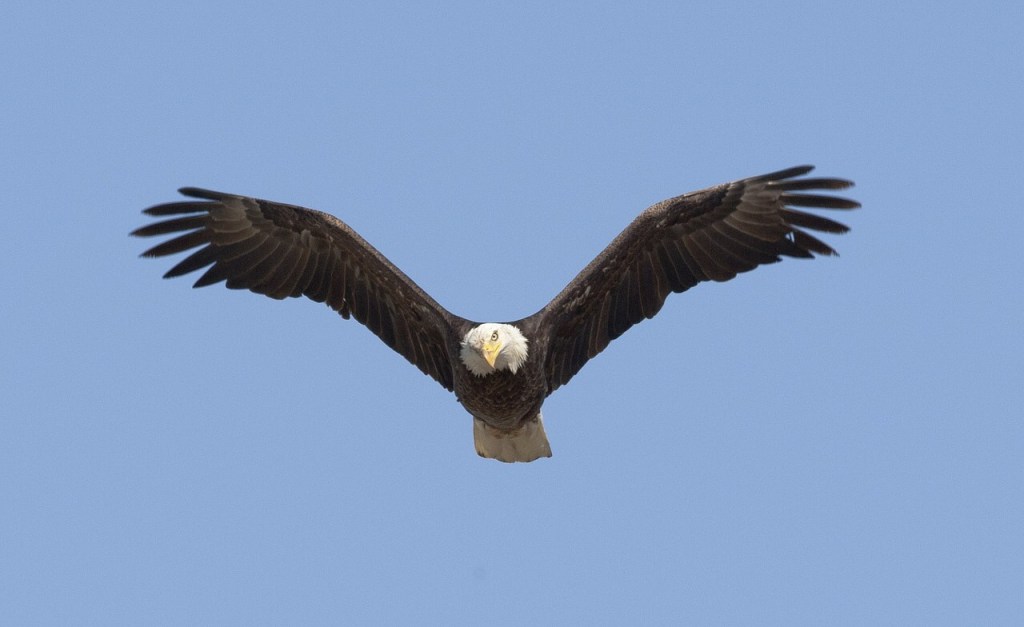
    Eagles are an important symbol in both American and Hopi culture. They are symbols of strength and courage and connection and vision. They are not passive creatures; they are creatures that do. That soar. And they are creatures of balance. The bald eagle uses their feathers to balance. As part of their growth process, if an eagle loses a feather on one wing, they will lose a matching feather on the other wing. It’s only when an eagle’s wing is injured, when their wings are out of balance, that they cannot fly.