Tag: children

  • Super Tuesday in Virginia

    Super Tuesday in Virginia

    We voted this morning. Taking our time, reading every name on the ballot with me whispering explanations about what I liked/disliked about each candidate and why who can win is sometimes just as important as who should win.

    Our children need to see and hear us talk about real issues, and know that we think and we research – not just that we blindly support a party or a person. Most importantly, I want Audrey to see and know that I will always vote for candidates who support her and the thousands of kids who will eventually enter adulthood with some sort of pre-existing condition.

    We talked about everything from socialism to racism to sexism, in littler words. She asked Are there people who won’t vote for a girl? Yes. And it made me sad to answer.

    But in only the way she can, Audrey summed up voting on Super Tuesday with this question/statement: So basically, though, we really don’t care as long as it’s not Trump. Yes. And, again, it made me sad to answer. It makes me sad that we have a leader I wouldn’t leave my children alone with for even 30 minutes because he’s such a poor example of humanity. I have voted red, blue, and Ross Perot, and have never felt that way until now.

    No candidate and no person is perfect, and yet I have always had this desire to really believe in the people I vote for. At the same time, it’s very often hard to find someone that doesn’t have skeletons and wasn’t at some point on the wrong side of an issue. But it’s never, ever been easier to vote for someone, anyone, as a comparison to what we have now.

  • Praying for Peace

    May our troops in harm’s way be protected. May their loved ones at home be comforted. May the children listening to bombs and explosions and gunfire know in their heart that that’s not the way it’s supposed to be nor the way it has to be – may their fears be calmed this night and in the coming days and nights, and may they grow up to believe in and seek peace. May peace take control of the hearts and minds of all the people who want to wage war. May all who need to be held accountable be held accountable.

  • Votes and Compromises

    Votes and Compromises

    Three years ago today I saw these images for the first time. They were shocking, and they made me angry, and they just made me really sad. I simply could not believe that a country full of mostly good people would elect a man who so poorly treats and talks about women. A man who didn’t value commitment in marriage. A man who looked at wives as an adornment in the lives of men.


    A man who speaks about women like this: “We could say, politically correct, that look doesn’t matter, but the look obviously matters. Like you wouldn’t have your job if you weren’t beautiful.” And this: “Look at that face. Would anybody vote for that? Can you imagine that, the face of our next president? I mean, she’s a woman, and I’m not supposed to say bad things, but really, folks, come on. Are we serious?”

    See original article and pictures here.

    See more quotes and references here.

    I’m not really a good citizen. I know I should care, but I just do not when it comes to things like interference in the election and phone calls with government leaders. The days of my naive belief in a country of people with values that holds leaders to a high standard ended long ago, when Bill Clinton stayed in the White House after his impeachment. I was genuinely surprised at that outcome – I thought he’d been caught in his lies, then tried and impeached, and that the consequences would rain down and he would no longer be the President. I wanted him to leave the office, even though I’d voted for him. It was my first of many lessons about how government and politics actually work, and more importantly about what people are willing to sweep under the rug or conveniently forget so that they can get their way or so that they can live in a world that is not so hard and not so messy.

    We’re spending all this time and energy and money on research and investigations and hearings…to accomplish what? Impeaching another President who will not leave office?

    If we aren’t capable of making the choice to not vote for a man who believes these things about women, it feels like our problems are so much bigger and deeply rooted. We aren’t just on the wrong path. We aren’t even close to the path.

    I believe that one day we are all going to be accountable for how we voted (or failed to vote). We may have thought we made the best choice we could, we may have told ourselves and others we were actually voting against the other person, we may have voted for him because of a single issue we thought he would support and so we decided to vote for him because of that one issue. But when you vote for a person – when you support a person – you actually endorse them as a whole. You don’t get to pick and choose parts of them.

    You essentially say I’m willing to accept a compromise on gun control so that I can support people with pre-existing conditions always having access to health care. Or I’m willing to accept bigotry because I want a certain kind of supreme court justice. Or I’m willing to accept someone who commits adultery because I don’t want to vote for a person who supports abortion.

    Or in our personal lives…I’m willing to accept inappropriate behavior with employees or vendors because my business may be at risk if I fire them. Or I’m not going to call out my friend’s bad behavior because maybe then I won’t have a friend.

    Compromise. Compromise. Compromise.

    And yet the reality, with politics at least, is that we’re always choosing a candidate who isn’t perfect and all of the people in our daily lives are human.

    At the same time that I can acknowledge we’re all human, I’m just disgusted with our compromises. Disgusted by how the election worked out. Disgusted at the thought that people continue to support this lying man. Disgusted at our waste in these impeachment efforts and our partisanship while children are on lockdown in our schools fearful of a shooter and Americans can’t get insulin because they have to make a decision between meds and food. Disgusted that the person who represents our country is not someone I would ever want my children to emulate or even be in a room with.

    I think what most people want is a world that just does not require us to think about and confront uncomfortable things. We want a daily life where we ignore how the people around us behave because we’re too afraid to not have friends or to be left out or to be alone. We can’t imagine how our life or our business can be without someone or something, and so we settle. Or maybe we are hiding and need a world that does not hold us accountable, and so we hold others less accountable.

    We must all choose, literally every day, in what ways we’ll compromise. Will we vote for people who support health care if they also support tighter border policies? Will we choose to be a real friend and call out bad behavior in our friends and family, or will we offer what is actually our quiet acceptance of bad behavior because we’re too afraid to upset the peace? Will we choose what’s easier now or what is right?

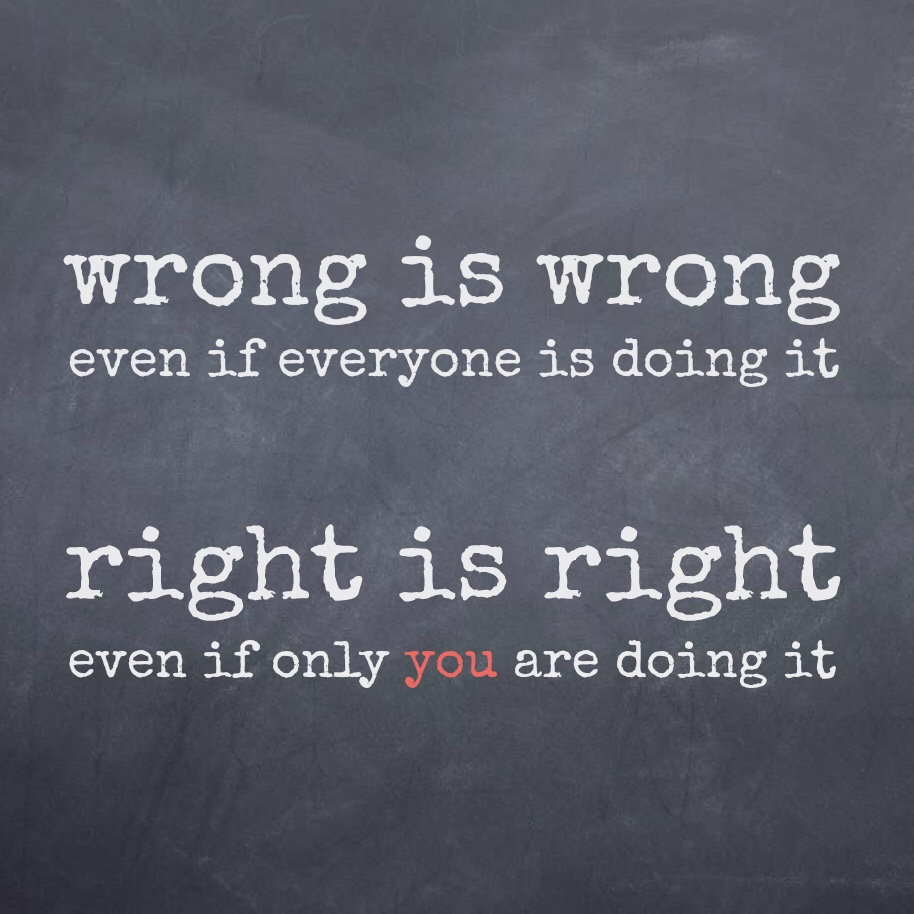
    We can’t keep thinking someone else will do something or someone else will say something. The reality is that we’re all going to have to compromise on some things but we have to be mindful when we do and we have to be able to explain it when we do. We have to admit what “whole” we accepted, not just focus on the parts we liked. And most importantly we must not compromise on the things that really matter – on the matters of right and wrong. We must always, always, always choose our children. And we must always, always, always choose right.
  • Compass or Baggage

    Compass or Baggage

    Love is never ever ever selfish.

    Love is never present when there are excuses or narratives or explanations. Love does not coexist with those things.

    Love is black and white in terms of its presence. It’s either evident or it is absent.

    If a person’s behavior is selfish, the only love involved is the individual’s love of self – not of others.

    Love is pure. And love is also honest. We cannot make something not honest and not pure into love. There either is love or there is not.

    Love is not just a feeling, it’s a commitment. Be it love with a partner or a friend or a parent or a child. And because it’s a commitment, people can sometimes learn that they cannot count on it once any commitment by that person has been broken.

    Children learn to believe in love, or not, at a very young age. They learn to trust in love, or not, at a very young age. They learn to live and love and treat others appropriately, or not, at a very young age. They learn based on the behavior of the adults in their lives, and they carry those lessons into adulthood. Those lessons are either their compass or their baggage.

    It’s our job as parents to be the absolute best example we can be. We will certainly fail at times because we’re human. But it’s our responsibility to work on those failures, to admit to our children when we’re in the wrong, and to constantly strive to be better. We’re not the parents of animals that primarily need love and care – we’re the parents of little human people who will emulate us and learn about love from us, and we need to behave like it. It’s our job as humans to be good people, and if we become parents that responsibility grows – we will be accountable for how well or how poorly we managed our human and parental responsibilities, in this life and the next.

    I can’t read 1 Corinthians 13 and say that even half of those statements apply to me. I keep a record of wrong doings. I get upset with others. I’m sometimes rude. I don’t patiently accept all things. And the truth is I’m not sure I want to work at changing all those behaviors. In some ways I want to remember wrong doings because I think it may help me make more informed decisions now. I have a lot to learn and a long way to go. I’m not the one who cheated, but that doesn’t make me a saint or any “better” at love. I didn’t sleep with my boss, but that doesn’t make me a saint or any “better” at love. I didn’t commit adultery, but that doesn’t make me a saint or any “better” at love.

    I feel the weight of the example I must constantly set. That weight is heavy some days. I worry about the example everyone in the girls’ lives sets – the messages we all send with our behavior. I fail greatly some days and that weighs on me because there’s really no second shot at many things. What my girls learn now about love and trust and commitment and honesty will be the compass or the baggage that they carry into adulthood.

    1 Corinthians 13: 4-8 Love is patient and kind. Love is not jealous, it does not brag, and it is not proud. Love is not rude, is not selfish, and does not get upset with others. Love does not count up wrongs that have been done. Love takes no pleasure in evil but rejoices over the truth. Love patiently accepts all things. It always trusts, always hopes, and always endures. Love never ends. 

  • Grief and Growth

    Grief and Growth

    Grief, according to Psychology Today, is the acute pain that accompanies loss. I’ve always thought of grief as a period of time following an event, but the older I get, or perhaps the more life experiences I have, I realize that grief is actually a lifelong process. Grief is not something people feel or experience within a finite period of time. And it’s also not something that hits you only when you’re in a slump or already sad about something else. In fact the opposite is true, and it very often hits when you least expect it – at a time of happiness.

    My grandparents died many years ago now but occasionally one of the girls will do something and I’ll think things like Uncle Dale would just love that ornery-ness in Audrey or Mama would not like this music but she would be tickled pink to see Ella sing in church. Sometimes those thoughts make me smile and sometimes they bring tears to my eyes, and I think that’s because I’m still sad that they aren’t here with us.

    Grief is not just about mourning a person, but it’s also about mourning the loss of a thing – a job, a child’s favorite stuffed animal, a home when you move. And it can even be about unmet expectations, including expectations you may not have even known you had.

    Children have expectations about their life that grow and mature as they get older, as their world gets bigger, and as they reach milestones. A young person who never had parents may still mourn the absence of parents on a prom night or a wedding day or even a dark day like one of a diagnosis. A child who used to live with two parents may suddenly notice a traditional family at a restaurant or even on TV and then be overwhelmed with feelings such as I only have one parent here.

    I don’t think I believe in the old adage time heals all wounds. I think our wounds *can* heal with time, but when that happens it’s because we’ve used our time and energy to think about all that’s happened and we’ve bravely faced all we did or did not see, all the choices we made, or all that we could not control.

    For children this is especially tough because they really don’t control a lot that happens in their early life. And one of the complexities tied to their grief and their moving on from something is that it can seem like their ability to accept a situation is a validation of poor decisions others have made. What is simply an acceptance of the adult, and a willingness to love the adult anyway, can be a very large leap for wounded hearts to make.

    A child’s ability to move on with their life or accept a situation is also not the end of grief. The sad truth hidden within acceptance is that standards have changed. With acceptance, expectations are often lowered – of people, of life, and even of God.

    Acceptance is supposedly the last stage of grief, but I think maybe the stages don’t always go in order. Or maybe they happen in order initially but it’s not just one cycle. Because what’s clear to me is that there are still days and moments of anger or sadness long after the days of acceptance.

    One of the hardest things to do as a parent is to watch your child grieve. Tears, anger, tummy aches, sleeplessness and yet constant tiredness. Perhaps the next hardest thing is allowing your child to grieve in their own way and their own time, all while not adding your feelings to their burden, rushing them, or trying to save them from it.

    I came across an old word a while back: nepenthe. If I’d paid more attention during Shakespeare lessons I wouldn’t have had to look it up. It’s something that makes you forget grief or suffering. Alcohol, people, work. Even good things can become unhealthy addictions as we search for a nepenthe. I think maybe the bravest thing we can do when we’re grieving is to forego nepenthe. The bravest thing we can do is avoid all the things that could make us temporarily feel better and focus all our effort on working through our loss and our feelings.

    I found that Shakespeare even nicely summed up all the thoughts I’ve been trying to wrap my head around: Tears water our growth.

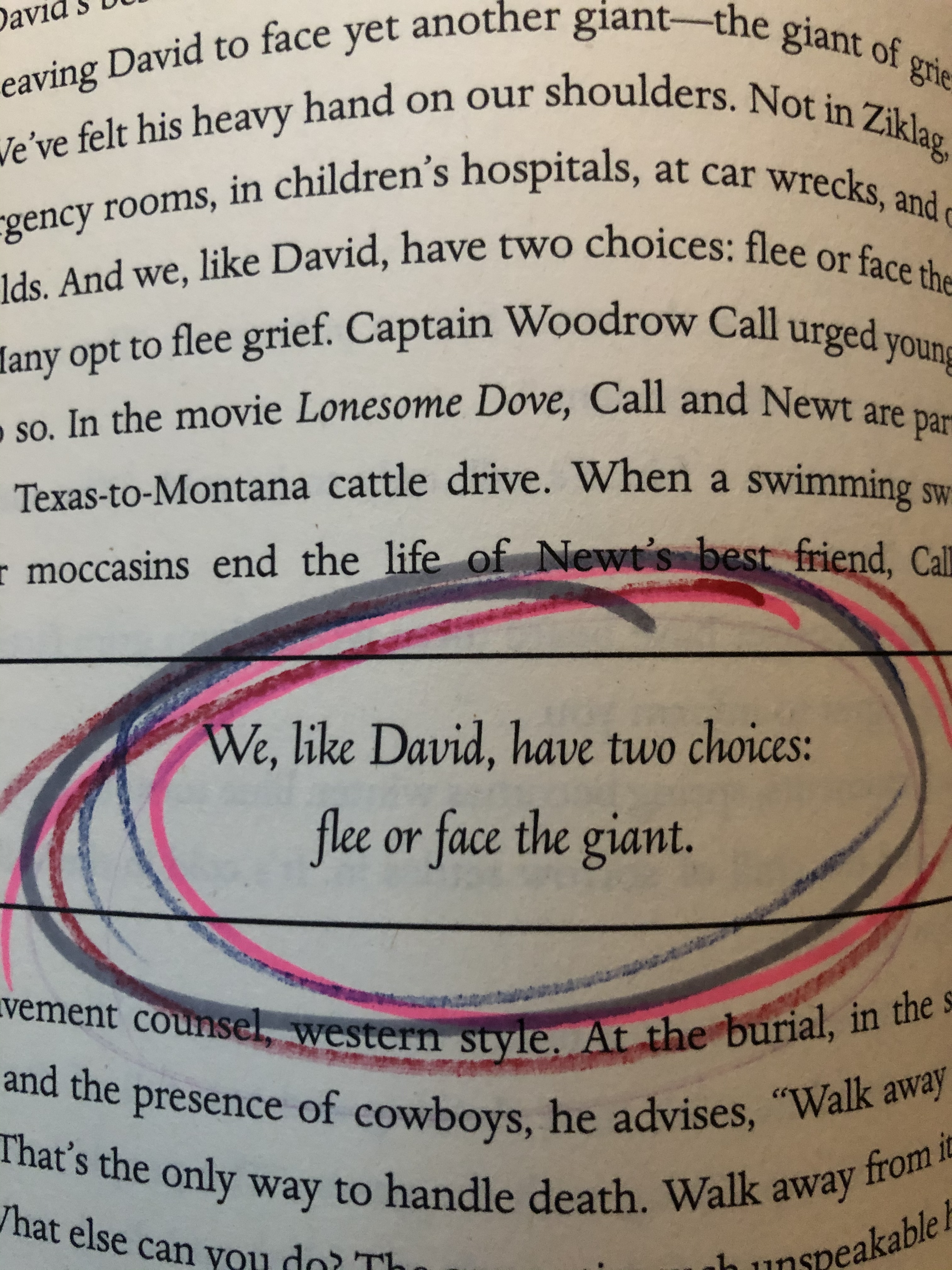
    Some time ago, I read Max Lucado’s Facing Your Giants. It’s about the life and choices of David, and about facing the giants in our lives. Grief is a giant. It often doesn’t reveal itself as obviously as Goliath did, so we have to be on the lookout. And when we recognize it, we have to bravely face it each time.

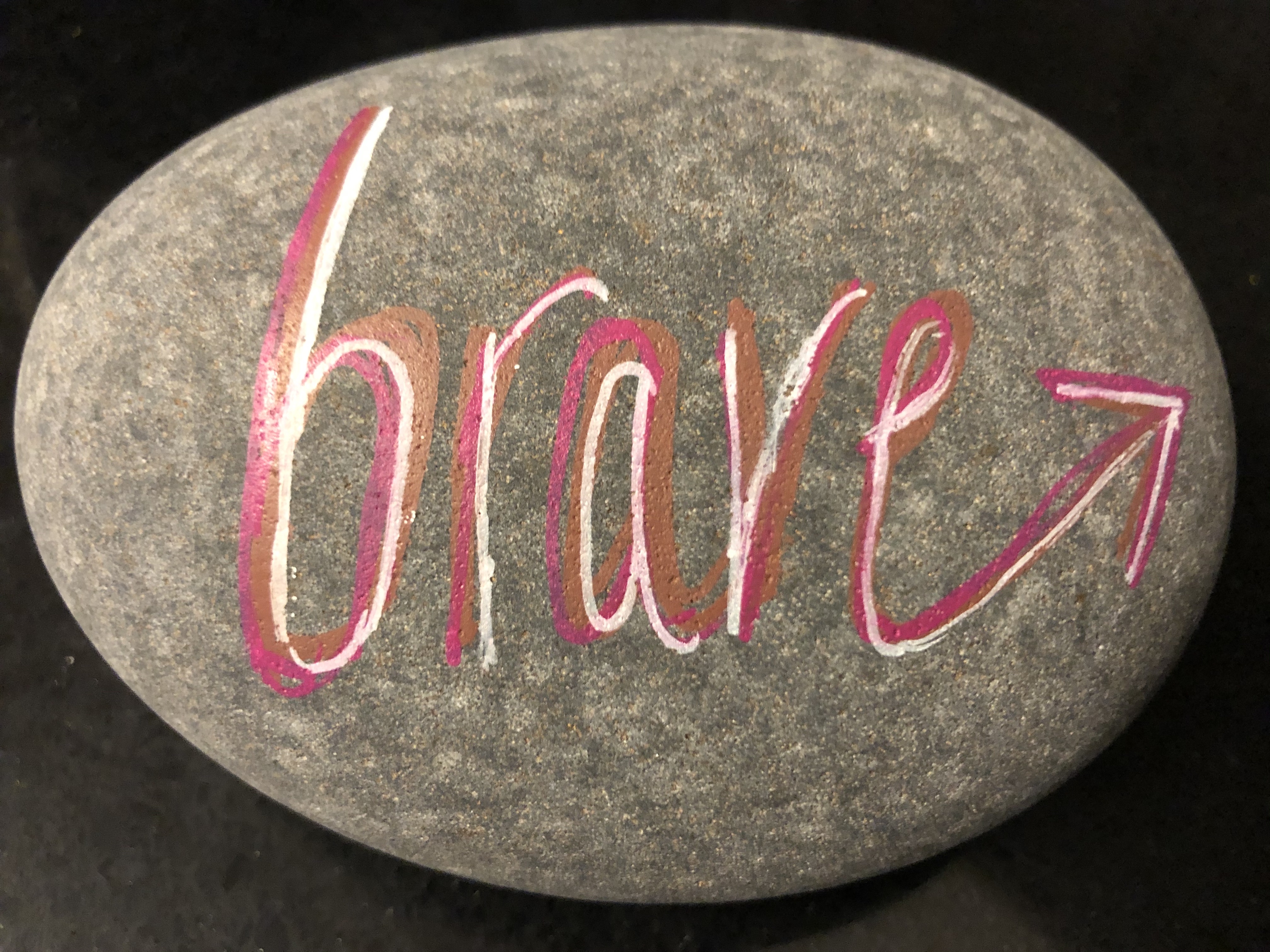
    Last week at a work event, our leadership team painted stones with messages that are important to us. I used three colors to write the word brave – a color for me and each of my girls. Brave is my battle cry and my encouragement. It’s also my reminder that David defeated Goliath with just a small smooth stone.