Tag: community

  • America the Great

    America the Great

    In the last week I have watched two documentary series about 9/11, and the thing that sticks in my mind above all else is how much we’re capable of coming together. Of helping people, while not even thinking about differences. We can just be good humans and good neighbors.

    If we could just figure out how to do that outside of a tragedy or a war, we might truly be great.

  • Goodnight Moon

    Goodnight Moon

    This week seems to be all about the moon. Full moon. Blood moon. Super flower moon. Moonbin rode a bike with training wheels (social media makes us dumber). And I even came back across the moon walk episode of The Crown.

    The moon can somehow be mysterious and comforting and ominous all in one week, or maybe even all at the same time. As a young person first reading and absorbing the not-so-common parts of the Bible, I was absolutely terrified by the thought that the “the sun will turn into darkness, and the moon into blood, before the great and terrible day of the Lord comes.” More recently, I’ve read Goodnight Moon to my girls hundreds of times – Ella always loved saying goodnight to the cow jumping over the moon and Audrey liked the little old lady whispering hush.

    Audrey and I stare at the moon sometimes as we talk at night, especially if her day has been a day. One great lesson the moon teaches is that we often only see one part of a thing – whether it’s waxing or waning in a clear or cloudy sky, we tend to focus only on the parts of things or times or people or situations that we can see, or that we want to see. And sometimes we do that even when we know there is so much more just beyond our current focus or line of sight.

    And then there’s the moon’s surface filled with craters, the result of space stuff colliding into it over however many thousands or gazillions of years, that reminds us that we can take a pretty severe series of hits – physically or mentally or spiritually – and still survive. Our scars, like those craters, bear witness to our strength and resilience and character.

    The moon is something the whole earth has in common. That people of all languages and locations and terrains and beliefs have in common. That humanity has in common. People all over the world look up at the same moon.

    We all share the moon.

    We all seek its light.

    The moon is a reminder that we are all a part of something a little bigger. That we are tiny and the world is vast. That sometimes the situations we think are insurmountable are actually very small.

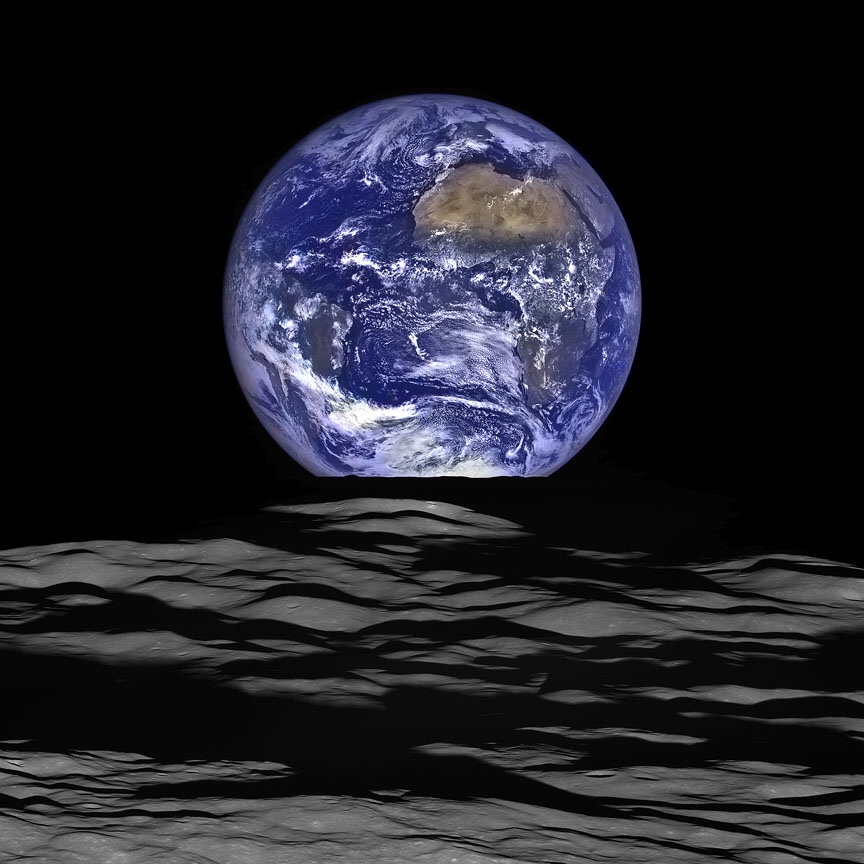
    Image from NASA’s Lunar Reconnaissance Orbiter , 2015.

    All of us that look up toward the sky to see the moon are more alike than we are different. Or maybe it’s more accurate to say we’re more alike as it relates to the core things. We want to live in safety and peace. We want shelter and food. We want to be loved and to be treated well. We want to be happy (and our saying for that is over the moon!)

    As I catch up on the news from around the world tonight, I can’t help but think about all the other people looking up.

    Goodnight to those facing sickness; may your bodies and minds find healing, and may you know you are not alone.

    Goodnight to those facing the impact of gun violence; may you be comforted.

    Goodnight to those listening for noises that mean danger; may you stay safe.

    Goodnight to those who are confused; may you find clarity.

    Goodnight to those who fear or are anxious; may your mind be at rest.

    Goodnight to those who are sad, for reasons you know or don’t know; may you find joy.

    Goodnight to those who are angry; may you be filled with love.

    Goodnight to those who don’t have provisions; may they find you or you find them.

    Goodnight to all the helpers; may blessings chase you down.

    And goodnight moon. May all who look upon you this night sleep peacefully.

  • What is Great?

    What is Great?

    I want America to be great. But sometimes that’s hard to even visualize when I look at where we are today.

    What does great even mean? That word has been co-opted by people wearing red hats and I’m not even sure that the majority of them can define the greatness we used to have that we supposedly need to get back to.

    Does great mean when we had prayer in schools? I think that’s what a lot of well-meaning Christians are holding on to. Prayer in schools is the panacea for drugs, pregnancy outside of marriage, respect for elders, vandalism, anger, and a thousand other things. But it’s not prayer in schools that’s going to fix those things. It’s prayer in our homes. In our cars at a stop light. In line at the market. And most importantly, in our hearts. “Prayer in schools” as the reason America has gone to hell in a hand basket is such a cop out – if you really want to point fingers, the end of prayer in schools began when we largely gave up on prayer in our homes and in our hearts.

    Does great mean before Roe v. Wade? Because abortion wasn’t invented in the twentieth century. It’s been around since the beginning of time, in the form of herbs and bloodletting and a dozen other precarious methods. And if Roe v. Wade is overturned it will still be around and practiced just as it is today, and just as it was before that Supreme Court decision – managed by individual states.

    Does great mean when women couldn’t own a home without a man’s signature? When men had a lot more “say” in everything? Or perhaps great refers to the time before Brown v. Board of Education or before the civil rights movement? Or does great mean before the immigration of people from non-white nations? Or maybe great means when the number of young people signing up to join the military was higher, when we were in the Cold War or just after September 11? I am a child of a veteran, I support our military, and tears still fill my eyes every time I see families waiting on piers for loved ones to come home. But sometimes I wonder if we are really a country that loves our military (wouldn’t we pay them more if we did?), or if we are more of a country of people that just loves to rally around a conflict and that live vicariously through the young people kicking some ass somewhere out there.

    I’ve yet to hear anyone who wants America to be great “again” define it in a way that makes sense to me, except for the people solely focused on money. And while I don’t agree on trickle down economics and tax cuts for wealthy people, at least they are real about their motives and I can respect that.

    I want America to be great. Not “again” though, because I think maybe it hasn’t ever been great for a lot of Americans. It’s been great for me, but I’m white and didn’t grow up in poverty or oppression. Part of being a good human, and part of being a good Christian for those of us that are people of faith, is not just caring about self. It’s also recognizing when other humans need help and providing that help if possible. And perhaps most importantly for today, it’s recognizing when other humans are discriminated against – by authority figures, by neighbors or colleagues, by laws and by systems – and standing against that. Setting WWJD aside, we should all be concerned about discrimination in any form against any American because history has taught us over and over again that if we allow discrimination against anyone, we risk being discriminated against as seasons change.

    As far as I can tell, “Make America Great Again” is about loving your neighbor if your neighbor looks and loves and prays like you, but sends cursory thoughts and prayers to everyone else. It’s a way to hide behind canned talking points because of motives surrounding faith and race and gender we don’t want to acknowledge, let alone speak about.

    Maybe this election cycle is more vicious and divisive because of who walks the halls of the White House and Capitol, maybe it’s because we’re actually at a tipping point morally, maybe it’s because we’ve all been quarantined and are just cranky and combative, or maybe it’s a combination of all of it. But I’m so tired of it all. I’m tired of “good” people – Christians especially – perpetuating the self-serving and idiotic belief that real Christians vote red and actively participating in or turning a blind eye to all the discrimination in this country. People are supposed to see Jesus through us, and we’re supporting and pointing them to politicians and programs and systems that do not reflect the love with which we are supposed to be filled.

    I’ve been reading Jesus for President by Shane Claiborne. I love how he characterizes the job of the disciples: “It wasn’t a call to take the sword or the throne and force the world to bow. Rather, they were to live the contagious love of God, to woo the nations into a new future.”

    I want America to be a place where all my neighbors – especially our nation’s veterans and children and elderly – have food and shelter and medicine. I recognize that’s a bit of a pipe dream given our current financials but is that so much to ask that we work toward? Why would those basics even be tied to one political party instead of core tenets of all political parties? I don’t care if your shirt has a donkey or an elephant on it, I have and will vote for you if you can show me you believe in the equality of all people, that you haven’t purposely mistreated people, and that you have empathy for people not like you.

    We have to stop being afraid of one another, of differences. We have to catch and stop when deeply rooted beliefs of favor or better rear their ugly heads in our hearts. We can love, and are called to love, our neighbor regardless of how different they are so that people see love through us, regardless of whether we are a Christian, Muslim, Buddhist, Jew, or Hindu.

    If we allow ourselves to continue to buy into canned talking points and excuses, which we tell ourselves and others to make us feel better, we will never actually work to make anything great. We need to start accepting responsibility for all the beliefs and generalizations and fears that we secretly harbor about people who are not like us, for all that we’re voting for, for all that we’re voting against, and for all we’ve been allowing.

    Sydney Ellen Wade, played by Annette Benning in The American President, said exactly how I’ve been feeling for months and maybe years: “How do you have patience for people who claim they love America, but clearly can’t stand Americans?”

    Our vote is never just for a policy we’re passionate about, it’s for the whole person whose name we choose. No matter our choice, some things about that person will be good and some will be bad. But we can’t say we’re voting just to save unborn babies or for health care, and think that absolves us of responsibility as it relates to supporting the character and integrity of the person we chose.

  • It’s Not Me, It’s You

    It’s Not Me, It’s You

    What if the one to blame is actually me? Or us? What if what we think is the fault of others is actually the fault of ours?

    We and us are Christians. Me, and maybe you.

    I’ve spent a lot of my adult life retraining my brain to not first think of God as the Old Testament punishment guy. He is the Old Testament angry guy, but He is also the New Testament love and peace and turn-the-other-cheek guy – and perhaps most importantly the forgiveness guy.

    We are in a crazy time right now in the United States. COVID, racial injustice, unemployment, hurricanes, fires. It seems like our nation is under attack. And, indeed, it may be.

    How’d we get here, and who’s to blame? Is it the radical left? The radical right? The looters or the KKK? Most of us live somewhere in the middle, and yet it seems like all of our talk is only about the folks on the fringe.

    We can’t ever allow ourselves to forget that the folks on the fringe are not and will not ever be in control unless we have allowed them to be. That’s the power of the middle, especially when it’s the size that it is. And perhaps our main issue right now is that many of us don’t see each other as fellow citizens, or as comrades, in that powerful force that is the middle.

    I am so very tired of hearing Christians say we need to turn back or we need to change our ways or we need to focus on values – with the implication or even the clear and intentional statement that if we don’t, our country is doomed to fall or fail.

    Maybe that’s correct, actually. But here’s the thing: when Christians say that, they are always pointing the finger at others. The implication in the statement is that others who sin need to turn from their way. Others who don’t go to church or don’t go to a church like ours need to get with the actual God program. Others need to have politics like ours. Others who are gay need to be straight. Others who have abortions need to stop. Others who commit adultery need to not do that. Others who protest need to be thankful for what they do have and love their country more.

    What about us? The Christians. Perhaps we should turn that pointing finger back at ourselves. What if the reason this nation is struggling is because we – the Christians – have set a very bad example in this supposed Christian nation.

    What if the issue is our failure to show Christ to the world? That we haven’t been the hands and feet. That we have failed to love our neighbor as ourselves. That we have failed to lead with love. That we have failed to be the light. That we have failed to forgive and have empathy and show compassion. That we have failed to live by the ten commandments. That we have put other gods before Him. That we have made idols. That we have supported and elected leaders who live in ways very contrary to the tenets of Christianity. That we have failed to preach and live the actual gospel. That we have been disobedient. That we have failed to take a stand when we should. That we have failed to recognize and act when some of our fellow citizens, including our fellow Christians, have not been treated fairly.

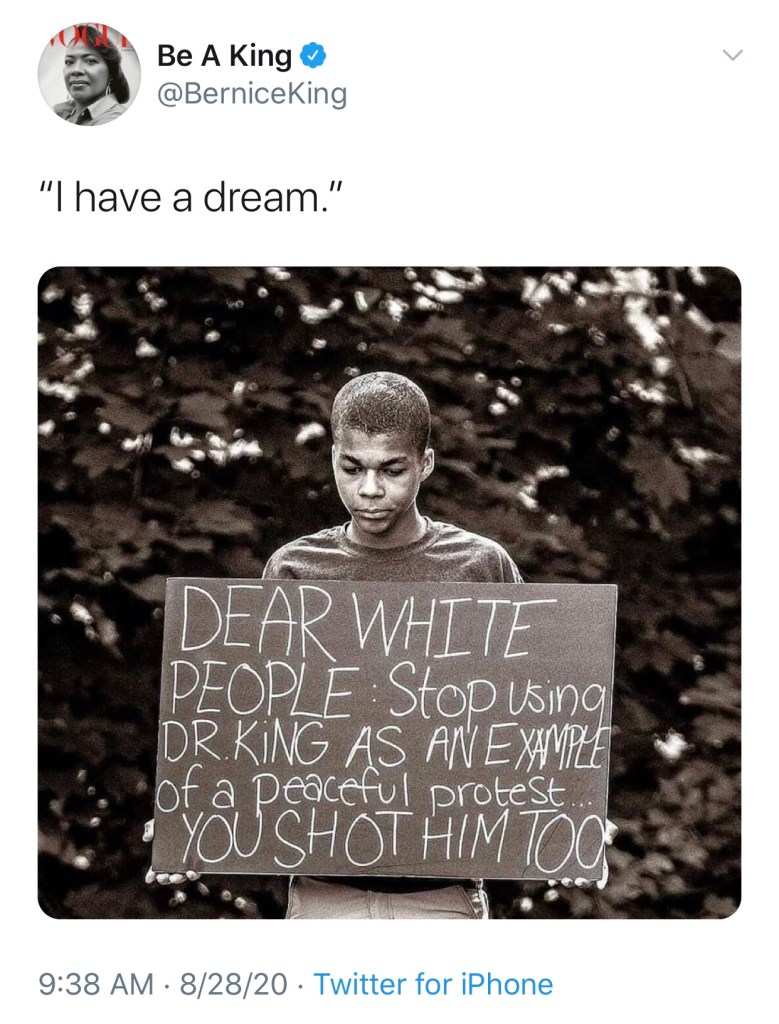
    Tweet that moved me most this week:
    Stop using Dr. King as an example of a peaceful protest…you shot him, too.

    What if WE are the issue? What if what we’re doing or not doing is to blame? Because as Christians, we have a responsibility that’s clearly outlined in Luke 12:48. To whom much is given, much will be required. We are and will be held responsible for what we have been given.

    We’ve been acting like the sinners are always the others. The sinners are us, too.

    We’ve been acting like we are above reproach because we are believers, when actually we’re more accountable because we know better.

    We’ve been acting like everyone should believe and behave like we do because we’re better, when the reality is that we’re not behaving very well at all. And worse, everyone sees it.

    I believe Jesus, if He were walking on two human legs in America today, might be found walking amongst that big crowd in the middle, in the group made up of most of us. There are differences in how we believe and look and think and act, but we commonly seek a place of peace and safety and healing. And perhaps he’d be speaking words like these, appropriate two thousand years ago and still today: “Blessed are you who are poor, for yours is the kingdom of God. Blessed are you who hunger now, for you will be satisfied. Blessed are you who weep now, for you will laugh.”

    There is surely Jesus in many Republicans and in many Democrats and in many Libertarians and in many Green supporters and in many people who don’t vote at all. Any suggestion that Jesus would side with a certain political party in America is simply a lie. Any suggestion that the fault for where we are lies with the others is a half-truth. The truth is always somewhere in the middle.

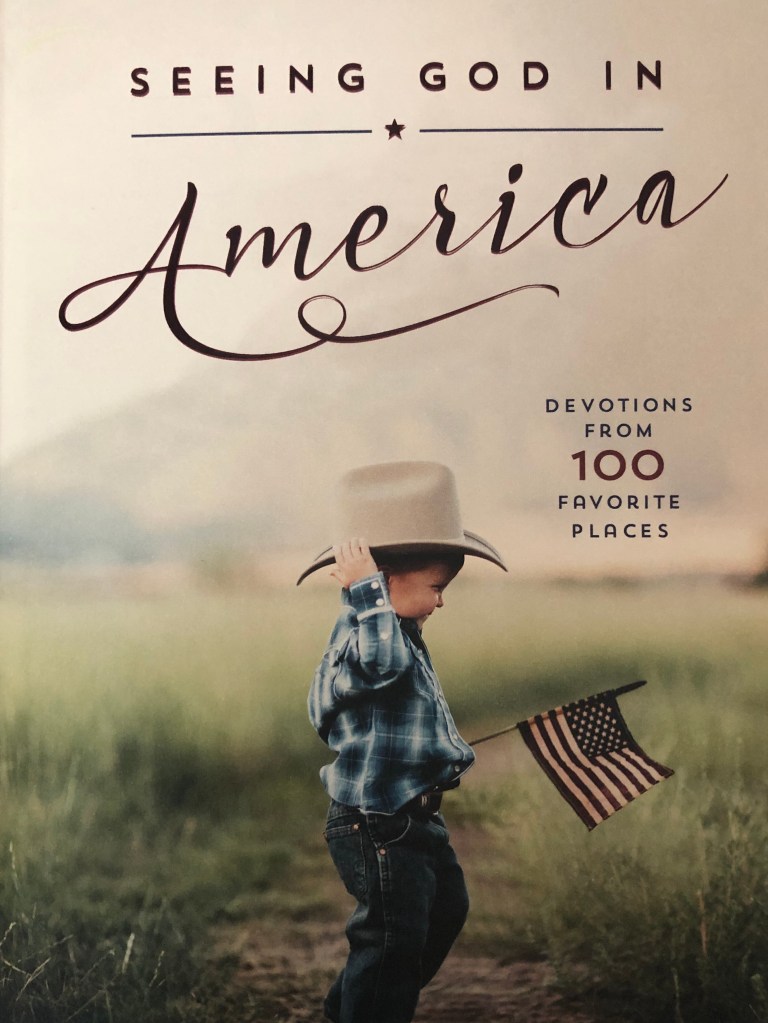
    Seeing God in America is one of my favorite devotionals right now. From a reflection on Maroon Bells, Colorado: “A murky, weed-choked pond won’t give back a reflection of even the mightiest mountains that tower nearby. But a clean, calm lake surface will shine out with the image of the majesty that surrounds it.”
  • The Stormiest Part of the Storm

    Hurricanes. Tornadoes. Earthquakes. Landslides. Fires. Volcanic eruptions. Diagnoses. Divorces. Death of loved one. Car accidents. Addiction. A child in trouble. War. Oppression. Terrorism.

    There are so many kinds of storms.

    People think I’m crazy for living in a place that’s prone to hurricanes. But I think it’s significantly more crazy to live in a place that’s prone to earthquakes. You don’t even know those are coming! Don’t even get me started on the level of crazy I think San Francisco folk have to be to leave their cars in potential cement death traps like parking garages. That’s just stupid C-R-A-Z-Y.

    With Florence headed toward the east coast, I’ve been thinking a lot about storms this week – storms we can prepare for versus storms we can’t. And what is the definition of storm, really? Is it just anything that is unsettling? Webster tells us storms can be a variety of things.

    • a disturbance of the atmosphere marked by wind and usually by rain, snow, hail, sleet, or thunder and lightning
    • a disturbed or agitated state, such as storms of emotion
    • a heavy discharge of objects, such as missiles
    • a tumultuous outburst
    • a violent assault on a defended position

    Perhaps the biggest storm of this week has been me. I am disturbed and in an agitated state and I have had outbursts. For the first time in two decades, I am facing a storm of weather that has the potential to greatly impact people I love and I have no one to rely on but me. No one to make decisions with. No one to second guess my logic or bounce ideas off of. No one to double check my list of to dos. If I make a bad decision about evacuating or don’t get enough food or water, people I love could really be impacted and it will solely be my responsibility and my fault. And that burden feels large.

    And you know what’s really silly? I have always really relied mostly on me because that’s just how I am, even when someone is standing next to me. Even if I had someone else in this house right now to bounce ideas off of and check my to dos, I would go with my gut on what to do and then blame myself if something went wrong. I’m a planner and I’m an organizer and I know that’s not everyone’s thing – and because I’m a little neurotic about lists and spreadsheets and planning (maybe more than a little neurotic), if something is missed or goes really awry, I am serious about going back through my checklist to figure out what the heck I was thinking.

    The one thing all storms have in common, I’ve decided, is that we truly can’t plan for them and they all kind of suck. OK that’s two things. Storms we don’t know are coming feel like a punch in the gut and that’s awful. But storms we can see looming on the horizon cause so much anxiety and stress that I think the knowing and waiting is actually the stormiest part of the storm. Is one kind of storm really any better than the other?

    We tend to define and even categorize whole time periods of our lives by storms. Life before a heart attack. Life after the death of loved one. Life before a job ended. Life after someone makes it to the other side of an addiction. Life before “the war.” Life after 9/11. Today is September 11, and with looking at just a few images I am easily transported right back to that day of surprise and uncertainty and overwhelming sadness. All of our lives have changed since that day – everything from our country’s foreign policy to air travel to our sense of overall safety within our borders.

    I tend to think of storms as an occasional small thing in the big scheme of things, but the truth is that storms are actually a pretty substantial part of all of our lives – and how we handle them and what we learn from them (or not) impacts the remainder of each of our lives greatly. One of the biggest lessons for me, and actually one of the great things about storms, is the way people come together to help and support one another. We see the worst of people in storms and we see the best of people in storms. Look for the helpers, Mr. Rogers would always say. Helpers are first responders, and helpers are family and neighbors and friends and teachers and doctors and nurses and counselors and people from Starbucks that we kinda know but not really, and even complete strangers.

    I allowed myself to get sucked into a pity party for a bit today. Because I forgot for a bit that it’s also my job to be a helper in a storm – to be a sister and a daughter and a neighbor and a company leader and a friend. I probably can’t get your generator working (God Bless Mark from Starbucks who helped me!), but I can call a friend who lives alone to make sure they have a plan and enough medicine.

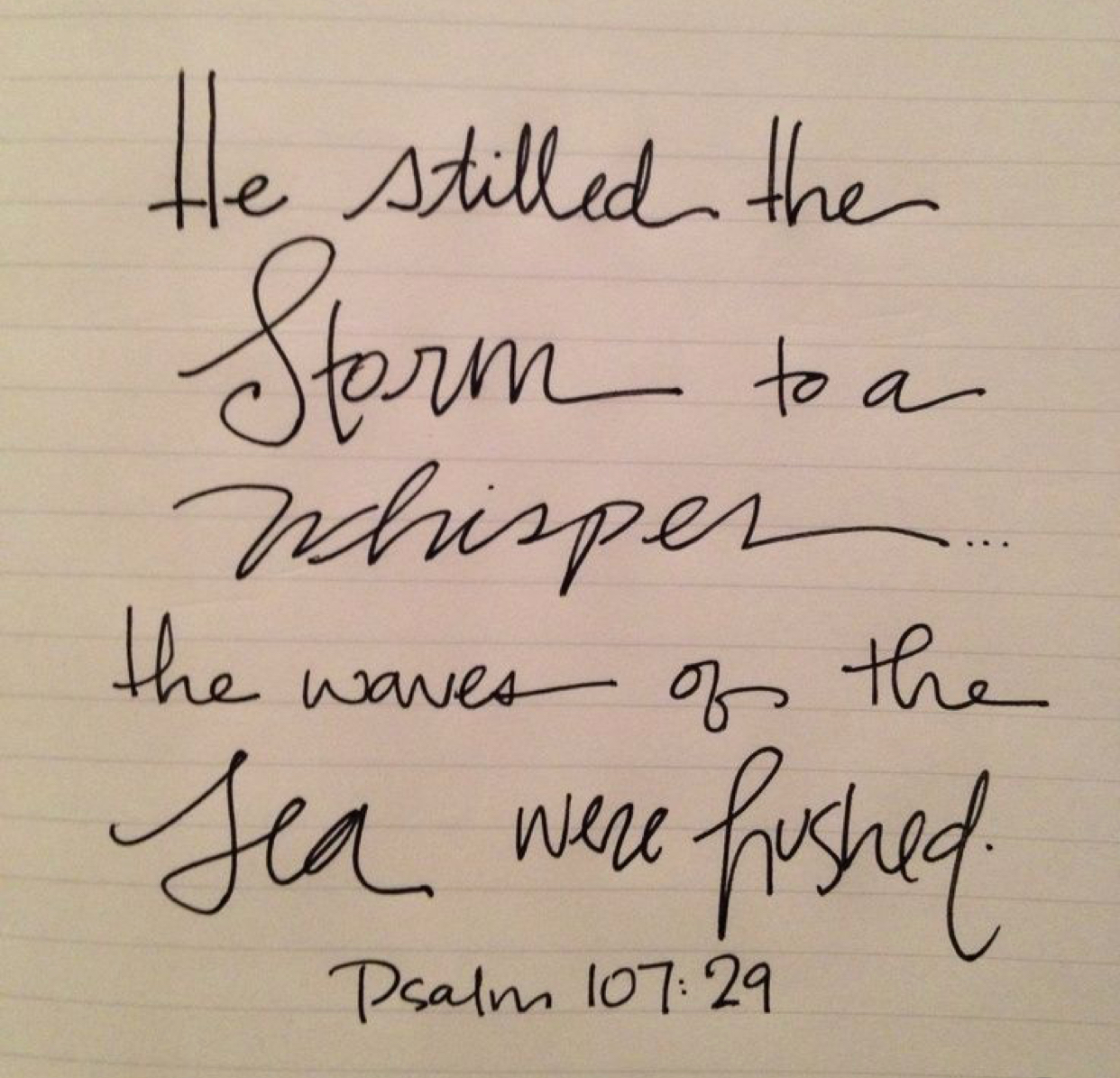
    I allowed myself to get sucked into a pity party for a bit today, because I forgot for a bit that one of my jobs as a helper and as a Mom is to project calm and not add chaos. And in a moment of divine intervention at just the right moment today, I came across this gem – and I literally laughed out loud as I thought it might be easier for God to hush the waves of the sea than it is to still the Storm that is sometimes me.

    IMG_E5528