Tag: christian

  • What is Love, Actually?

    What is Love, Actually?

    This is easy: it’s something about Hugh Grant.

    Just kidding. I don’t really think it’s Hugh Grant, but at the same time I’m not sure I have the ability to help children understand the answer to that question – at least as it relates to big people being in true love. It’s a subject I’ve been mulling over for the better part of a year, and it brings up an even scarier set of questions all related to this one:

    Can children really understand what love is in the absence of good examples?

    Of all the things I have mourned as part of the divorce process, the thing I have mourned more than all else combined is the impact on my girls. Adults are big people and equipped to survive crappy things. Strong people pick themselves up, take time to address what’s broken, and move forward. But children don’t have all the coping skills and life perspective to rely on when crappy things happen. They mainly rely on adults to guide them, and relying on the guidance of divorced parents is OK in terms of learning how to get back on a bike after a fall or advice about a bad grade. But can children understand what love is when surrounded by adults who don’t display love properly, or at all?

    My gut reaction: oh, heck no.

    But that’s absolutely incorrect, and I am certain of it not because of what I’ve read or because of what a psychologist says or because of the encouragement of people who mean well but will tell me what I want to hear to make me feel better momentarily. I am certain of it because of a conversation with my daughter.

    Just a few months into our family changes I was a bit horrified to find that my girls were talking to me about me dating. Not only was that not at all the space I was in, I didn’t want them to think that you always need to have a person in your life or you just replace one person with another. So I focused our discussions toward a couple of key things:

    1. People do not need a partner to have a wonderful life.

    2. There’s no reason to fear being alone. You don’t find real happiness in others and you don’t date or marry someone to feel whole – you can and should be whole all by yourself.

    What I didn’t realize until I talked to a helper is that the girls were really just conveying they wanted me to be happy. That they thought if I fell in love I would be happy. And that’s sweet, but it’s also scary because I want my girls to not equate happiness with other people. I want them to love themselves and know God loves them and feel so loved and secure all on their own that they never feel they must have a partner – yet they will embrace one if they find and want one. But how could they know what love really is when all they’ve witnessed close up is a relationship that ended in an unexpected virtual propane explosion and then a relationship between two people who were/are not faithful in their marriages.

    How could the girls possibly know, and how could they possibly learn, what love really is? How could I even begin to teach them?

    My first thought was I could point out examples of good people they know who’ve gotten it right. Of course no two people are perfect and no marriage is all about a sweet love story, but I found myself saying “You see them? They work hard at it and are dedicated to each other and they got it right.” But that didn’t seem like enough. What if that relationship ended up not working out? What if a year from now one of those seemingly good people that everyone thinks is such a devoted spouse and successful human turns out to secretly be someone else entirely? It wasn’t going to be enough to show them good examples.

    My second idea was to point out what love isn’t. This could be a really seriously long list – but boiled down, it’s actually pretty simple: if shame or dishonor is in any way a component of a relationship, that’s not love. If you feel any shame about the person standing next to you, that’s not love. If you’re with someone who has dishonored or mistreated you or you’ve dishonored or mistreated them, that’s not love.

    Next was talking about the words “I love you.” Plenty of adult people are in relationships and say “I love you,” but that doesn’t necessarily mean they even know what love is. It might just mean they know how to speak words – maybe they love the idea of love or the idea of love with someone specifically, but they could have no idea how to actually love properly. Anyone who says “I love you” but dishonors you when you’re not around does not love you – they are lying to you or themself or both. Anyone who says “I love you” but dishonors your children does not understand what love really is. Love is always going to be a good bit about faith and trust and selflessness and respect – lack of faith or trust or selflessness or respect smells like like or convenience, not love. Don’t just say words: say words only when you are sure what they mean and you actually mean them.

    Step four in this process was to say and actually mean that I believe in love. Because if I don’t believe in love, how can I really expect my children to have healthy views and feelings about love? Step four took some time, but I got there. And the moment I realized I still believe in love was coincidentally the moment when my daughter spoke words that showed me she knows some of what love is really all about.

    We were sitting in church, and a few pews in front of us were A+K. And my daughter leaned over and whispered to me, “Did you see him put his arm around her? You need that.” I gave her side eye – I’m fine by myself, thank you. Mom, you need to be with someone who will go to church with us. And I realized in our discussions about it she saw so much more than just a warm body with an arm to lean against. It was two people with shared values, two people who work together to meet commitments, two people who prioritize family, two people who support one another, two people whose lives have not always been easy, two people who are not perfect, two people who worship together, two people who clearly love and are proud of each other.

    The girls can understand and experience love regardless of their parents’ examples. I had forgotten for a while that the girls have the perfect example of true love and they’ve been learning about it since they were babies right in that very building with the pews. We – me, you, them – are so loved that we were given clear instructions for love and a clear definition of love that we can always use as a benchmark whenever we’re confused.

    1 Corinthians 13 New Life Version (NLV)

    Love does not give up. Love is kind. Love is not jealous. Love does not put itself up as being important. Love has no pride.

    Love does not do the wrong thing. Love never thinks of itself. Love does not get angry. Love does not remember the suffering that comes from being hurt by someone.

    Love is not happy with sin. Love is happy with the truth.

    Love takes everything that comes without giving up. Love believes all things. Love hopes for all things. Love keeps on in all things.

    Love never comes to an end.

    One of my favorite movies is Love Actually. I’ve watched it a ridiculous number of times over the years, mostly because Hugh Grant is bloody swoonworthy. Little Sam has always been my favorite. He’s so sad and grumpy and so forlorn and so scared and yet still a bit hopeful. And he’s young and had so much tragedy that you really, really want his first love to work out – more than any of the other story lines, you want Sam’s to have a sweet and happy ending. For the first time, in a recent re-viewing, I realized that Sam has a parent who is somewhat like me – a parent who wants his child to believe in love and to take the risk, because ultimately it’s so worth it.

    Watch: Sam has a problem.

    Watch: Sam has a plan.

    Watch: Sam gets his kiss.

    Love Actually is a group of relationship stories, some about love and some not. Just like the stories of people in all of our lives. In different viewings at different times, I always seem to focus on a different line as THE most interesting one. My viewings the last year or so had me focusing on Karen, who warned her husband about that woman at the office. But when I caught it midway recently, flipping channels, I remembered how much I rooted for Sam the first time I watched the film. His story has always been my favorite. I love this line specifically, which you should be able to say with pride in some variation at decade one and decade two and decade five about the person you love to the other people in your life that you love: “She’s the coolest girl (guy) in school.” Actual love grows and gets better with age.

    Now click here, or below, to watch Hugh Grant dance.

  • Don’t Hide Half, Brave Girl

    Don’t Hide Half, Brave Girl

    One of the fastest ways to make me angry is to tell me half. “My room is clean now” sounds great, but it’s really only half if you’ve shoved a bunch of candy wrappers under the bed. “She hit me” is only half if she was pinched first. “This car would be cheaper than the one you have now” is only half if the new car comes with no warranty and requires more expensive gas.

    Just tell me the truth already. Because half is not truth. Truth is always whole.

    I’ve been thinking a lot about happiness lately. What makes people happy, does everyone have a right to be happy, is it wrong to be happy when people we love are not, is it weird to be happy when your life has a big problem in it? Is hope the key to happiness? Or faith? Love? Xanax?

    I’ve decided that people who say happiness is a choice are right, but they are really only telling you half. The key to happiness is not in any choice in something external – it’s not in love, not in the achievement of a goal, not in a person, and not even in a faith of some sort. Anyone can choose a mate or a puppy or a bottle or a cause or a church. But none of these things, these choices, will ever be enough to get you to happy. And that’s because the real key to happiness, I am convinced, is 100 percent internal – it’s in learning to like yourself, it’s in living in a way such that you can like yourself, and then in simply owning who you are.

    If we are honest with ourselves about who we are, and if we like ourselves when we’re alone with ourselves, we can be happy. And if we can be ourselves no matter who’s around and no matter where we are, we can be happy. But if who we are is different based on who we’re around, one of two things is true: either we don’t know who we are yet, or we are well aware of who we are and we don’t want others to see that person. It’s when we speak half or live half – only showing a part of ourselves in hopes others will like us – that prevents us from being wholly happy.

    We must stop living half. And we must stop half-telling our story.

    If we tell people we need forgiveness for hurting others because we struggle with an addiction or a disease, but in private we don’t seek professional help to help ourselves…we’re telling half.

    If we only show people the pictures where our hair is in place and our house is clean…that’s half.

    The thing about our halves is that we may be hiding them from others, but we’re not hiding them from ourselves. We know we’re showing half – and if we’re at all good people, we can’t really get to happy by showing half. The halves that we hide because we’re ashamed of them or because we think they make us the most unworthy or the most bad will actually lose their power over us when we own them. It’s in our transparency, in our ability to reject the urge to only show half, that we find the freedom to be happy.

    Real humans have a whole story, and in every one of those stories the human is imperfect and/or their life has something wrong with it.

    This weekend I watched a group of young people tell my seven year old they missed her at an event a while back. Her face fell and her entire countenance changed. Her confidence was gone in an instant, and that’s because she remembered why we missed it – she doesn’t have a traditional family anymore and that’s been a very tough reality for her to accept. And just as I was about to smooth things over, she blurted out that her Dad doesn’t live with us anymore and he has a different life. I could not have been more proud that she spoke a truth that hurts her deeply. And two seconds later my heart burst with gratitude as I watched a teenager reply, “Yeah, my Dad, too. But I’m still gonna be a doctor. What are you going to be?”

    I realized in that moment – the moment where I almost spoke half to smooth things over, which would have cheated my daughter of a wonderful moment – that not only does our transparency about our whole self and our whole life allow us to free ourselves of a bondage, it also allows us to see that others are like us. If we don’t share our whole selves we can’t possibly feel the grace and love others have to offer us. If we live and speak only half, we’re essentially cheating ourselves of our ability to heal.

    I’m determined not to live and speak half – not just because I’m not smart enough to keep up with all the omissions, but because I want to spend my life doing stuff other than hiding and pretending.

    So…I go to church and yet I sometimes drop F bombs (especially when in traffic). I’m a Mom who doesn’t like to cook and I’m a Mom who embraces restaurants. I will not hide that from bus stop Moms who are good cooks. I’m a Christian who has gotten so angry that I have shouted that I hate people and that I can’t wait to attend their funerals. When my pastor asked how I was doing later that day and I said “fine,” that was half. Because while I am actually a good bit more than fine at this point, there’s still a shameful, angry truth – a half – that I hide.

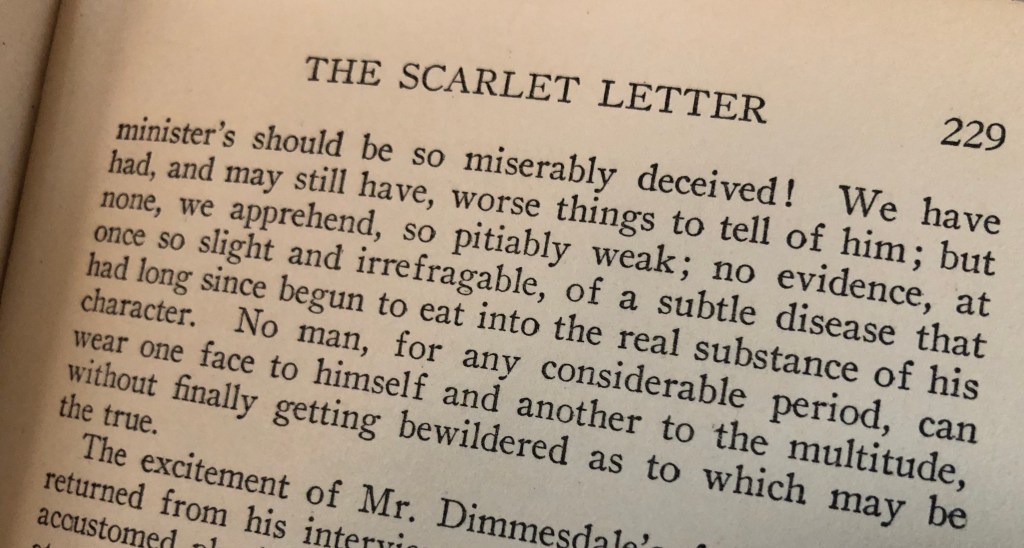
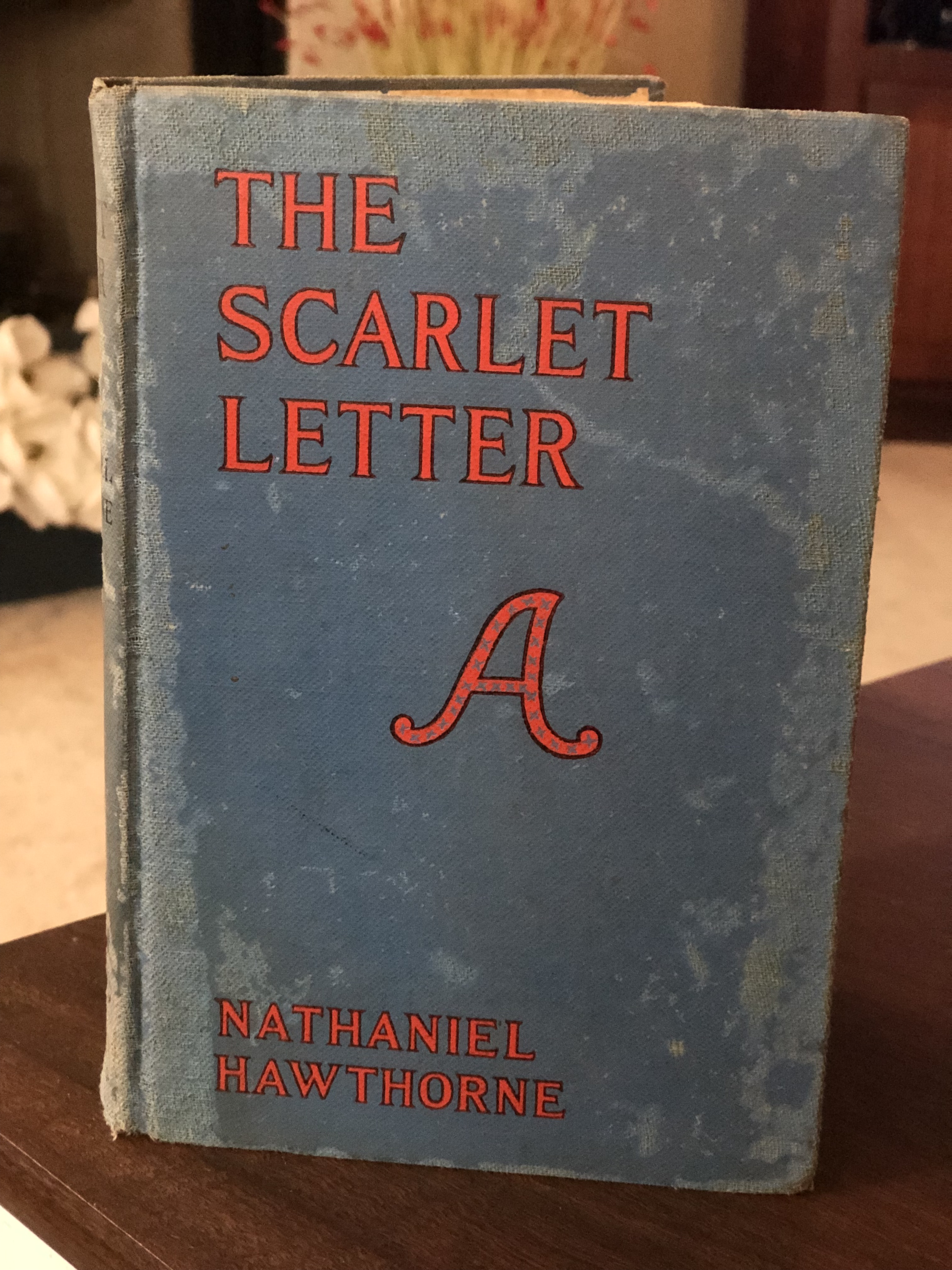
    A few months ago, I was wandering around an antique store and I came across a couple shelves of old books. To my surprise and complete delight, I found an old copy of one of my favorite books: The Scarlet Letter. I read it the first time in high school, loving the story but thinking it was outdated and didn’t really apply to life now. That was more than 25 years ago, and I’ve found The Scarlet Letter speaks to me today more than ever. While I’d love to see some people have to wear a scarlet A upon their chest, that wouldn’t send a message most people around them don’t already suspect. The timeless message is this: “No man, for any considerable period, can wear one face to himself and another to the multitude, without finally getting bewildered as to which may be the true.”

    I’m not bewildered about who I am. I know I’m a person who doesn’t really wish harm on others and that loves people and that does her best to live the right way and that is a Christian…but still, that’s just half. I’m a Christian who has a heart that has hate and anger in it, and that’s not a half of which I’m proud.

    But you know what? That’s my whole.

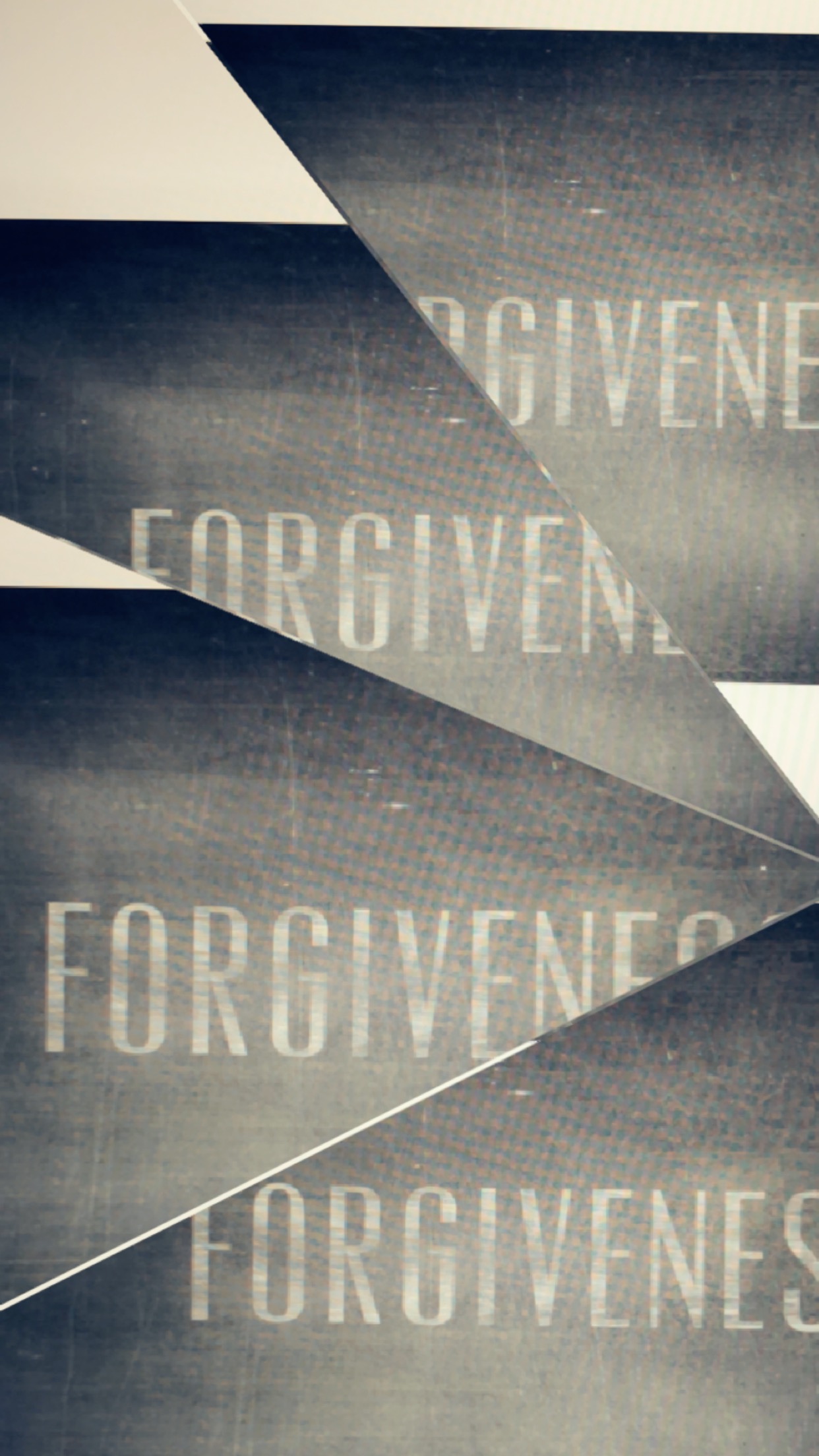
  • Fractured Forgiveness

    I have a habit of being in the middle of multiple books at one time. If one is a romance novel and one is biography of Mother Teresa and one is about the habits of highly successful people, I’m on pretty solid footing in terms of not confusing things in my mind. Books typically fall pretty easily into a category, and you can pick one up and dive right back in where you left off – almost right into the thought you had when you last put it down, just like when you turn off your car in the middle of a song and when you get back into the car you find yourself ready to sing the lyrics where the song left off.

    My work book club just finished reading Leadership and Self-Deception, and it has me not on solid footing. Every time I picked it up, I felt like I was lost a bit and couldn’t find my place. It was annoying and irritating, especially for what’s a pretty basic tale of two different kinds of people: people who are in a box (bad) and people who are not in a box (good). The premise is that people who are in a box can’t be good leaders because they are self-focused and not self aware. They don’t view others as they are or view the world as it is, and instead view everything in relation to self. People outside the box appreciate people and see their value and see them as they are.

    Today was our last discussion on this book and our group made lists of the character qualities for people inside the box and people outside of the box: inside people are limited and objectify and are judgmental, while outside people are listeners and are open-minded to new ways. As the character lists took shape something started to click in me, but it didn’t solidify and the annoyance persisted. So I left the meeting glad to see that book club end and glad to put that book on a shelf in my office.

    It wasn’t until an unrelated conversation with a smaller group of the same work friends that a realization started to really take root. We were laughing and telling old stories, and I jokingly said something cynical – and it hit me like a toilet from outer space in the first episode of Dead Like Me that the word “judgmental” applies to me.

    Mom Beth is outside the box. She encourages and praises and believes her girls can do anything. She does the same with all their friends – she wants these girls and everyone around them to believe that they can be and do anything. She has ways she likes to do things but she really works at letting her girls do things their own way and at their own pace.

    Work Beth is outside of the box. She loves the people in her office and is excited when they succeed and when they have new ideas. Work Beth is Mom Beth. She can’t say that at the office because it might offend some people – but she is a smiling, proud Momma each time they meet a goal.

    Christian Beth is outside the box. She loves different kinds of worship and talking about philosophy and she thinks that all different kinds of Christians will see each other in heaven – Baptists and Methodists and Unitarians and Catholics and Pentecostals and all sorts of others whose names I can’t recall right now. She believes the Bible and science can go together.

    Work Beth is Mom Beth is Christian Beth. Beth is the same no matter where you encounter her, and she is outside the box.

    But I realized today that that’s not really true recently, and that’s why I am annoyed at this book. There’s an Internal Beth, and that Beth is angry and that Beth is judgmental. Judgmental is an inside the box characteristic. The Beth that firmly believes a criminal deserves grace and can be forgiven cannot extend forgiveness to people who changed her children’s lives forever. The Beth that believes that all sin is equal in the eyes of God and the Beth that knows that she is not perfect and she is a sinner secretly harbors an equally firm belief that some people deserve lives filled with pain and misery.

    Self-Betrayal is clearly defined in the book: when you know how you should act and you choose to act differently.

    Coincidentally, I’ve been reading about and thinking a good bit about forgiveness. I just didn’t connect it all until today. I am well aware that I need to forgive. And yet, I am not there yet. And not only am I not there yet, I don’t even want to forgive certain people. So as awful as it is and as it sounds, the truth is that I am thankful for my own forgiveness and I don’t want to forgive all others. I only want to forgive as long as it’s within certain parameters and yet that’s just not how forgiveness works.

    Forgive us our trespasses as we forgive those who trespass against us…

    My forgiveness is fractured. It’s like a bone that’s cracked. And we all know what happens when bones are fractured and not properly treated. Pain and swelling and discomfort.

    I can’t decide if I think forgiveness is brave. Can something that’s mandatory also be brave? God calls us to forgive and so for me, words like expected and mandatory do not go with brave.

    And yet brave or not brave, I have to do something about forgiveness. Because fractures heal one way or another with time – properly or improperly. Doing nothing is a decision to choose a lifetime of complications.

    IMG_5685