Tag: freedom

  • Mid-Life

    Mid-Life

    There are five basic stages of life: child, teenager, adult, mid-life, and old. Not all of these stages have clear parameters in my brain, but as I am not yet retired, I am not yet old. So that puts me firmly in mid-life. Or so I thought, until my old boss pointed out that mid-life is not 50 unless people live to be 100. I’m 53 years into life, and math has never once made my day better.

    I don’t know that I ever gave much thought to midlife before now. As a kid, I couldn’t wait to be a teenager. As a teenager, I couldn’t wait to be an adult. And once I became an adult, life became a whirlwind of career, kids, responsibilities, and deadlines. The only thing I have really looked ahead to and planned for is the retirement years. But it turns out, these midlife years aren’t just flyover states on the way to old age. They’re actually a pretty awesome destination all on their own.

    The girls are older, and more and more they have their own lives. And that means for the first time in two decades, I have the time and freedom to do and explore things simply because I want to. I’m learning what it feels like to be Beth again, not just someone’s mom.

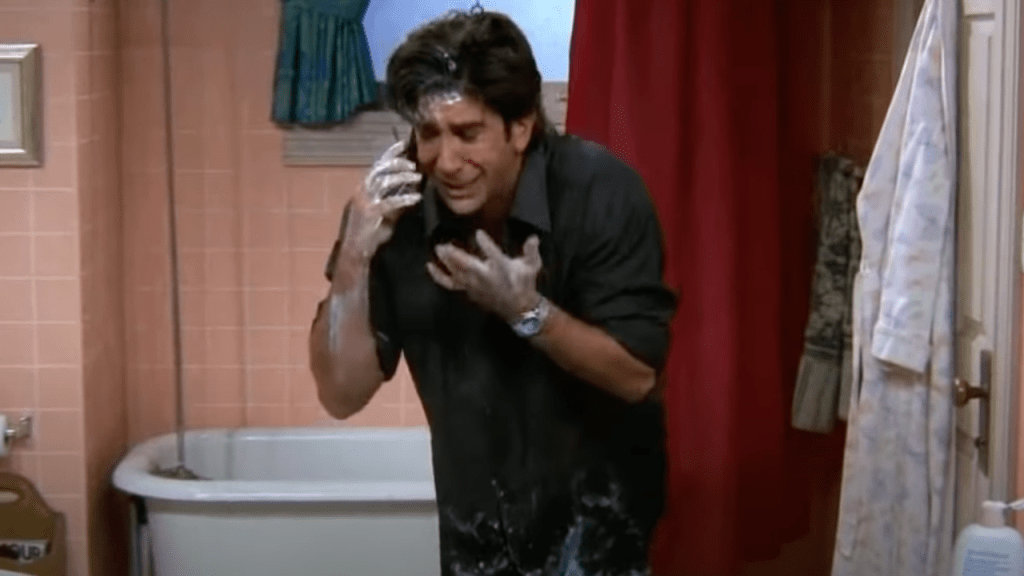
    I have to snap because my girls snap, but mid-life me does it from my antique rocker. This should be called the Take On Me filter.

    I’m increasingly convinced that this stage is a very important part of God’s plan for our lives. It’s not a winding down, but more of a commissioning. Life experience plus the unique gifts God gives each of us plus time equals our ability to do the work only we can do.

    Maybe that’s why this season of life feels so good, with so much added energy and joy. I’m no longer chasing the next destination. I’m growing into the person God has been shaping all along.

    At the same time, mid-life is not for the weak if you’re a girl. Seriously, we carry and birth the babies, and then we’re rewarded with not one, but two stages of menopause? Midlife is spiritually rich, emotionally freeing, and hormonally outrageous.

    In the midst of all the mid-life awesomeness, there are these kinds of thoughts each day.

    AARP is not for mid-life, it is for old age. Stop sending me mail. If you want me to sign up in this stage of life, one of your discounts should be with Dominion Power so AC can be cheaper. I need lots and lots of AC and it costs lots and lots of money.

    If I’m in the ER at 2 a.m. struggling to remember basic information, it’s because I’m a morning person and this is not my best time of day. Midlife patients need nurses who understand this. And if I joke that I don’t need a dementia test, that’s your cue to laugh. I don’t care if it’s fake.

    When my car needs service, I should be able to Google Toyota on Laskin Road and get a human. Or even a bot. Instead, I call three different numbers asking for Ken, and no one can find my record. AI can break into government websites, explain complicated science things, and enable political folks to create stupid images, but what it really needs to know is which Toyota dealership I mean.
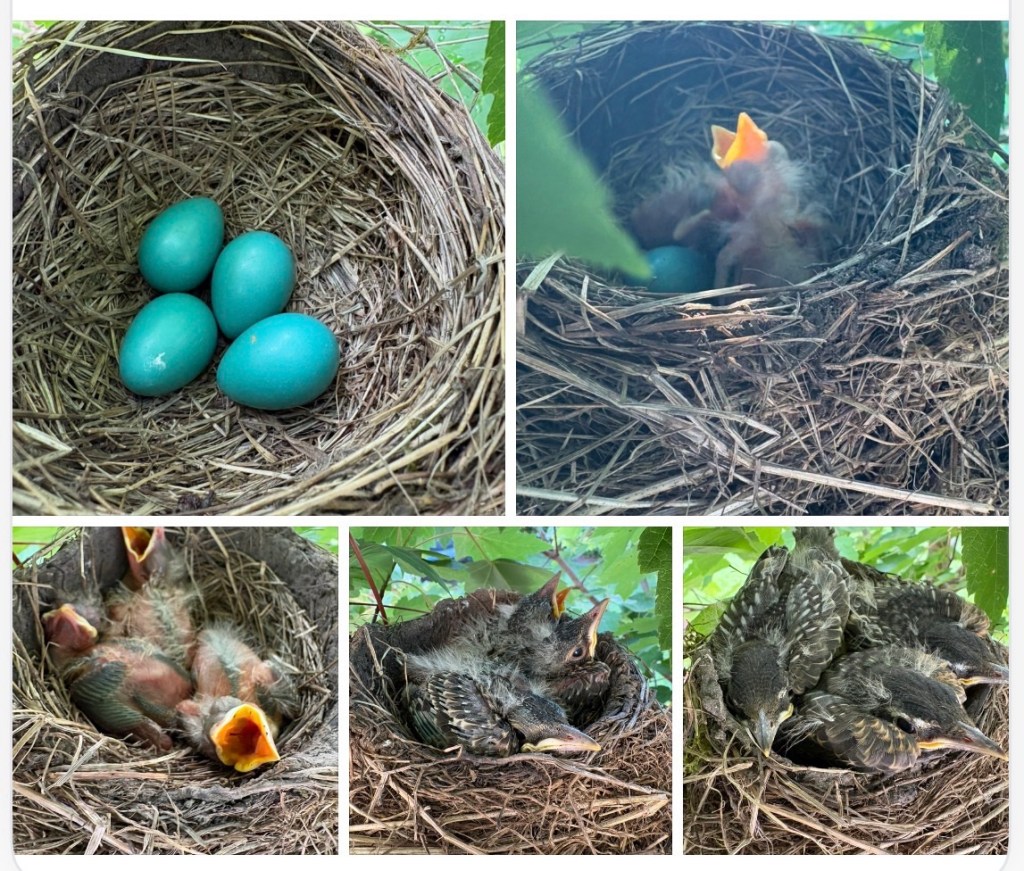
    Stages of life in my back yard this summer!

    I spent the first half of life becoming a grown-up. Even now, I’m still the middle schooler who laughs at inappropriate jokes. Somehow, God has taken all the pieces of me that never seemed to go together and fit them into something beautiful. Mid-life is where you finally start to see the puzzle come together, and it’s so much better than I ever imagined.


  • Beatitudes and Bias

    Beatitudes and Bias

    The past year in the U.S. has been hard to watch. The people we’ve elected, the decisions we’ve supported, the direction we’re heading. It all makes me mad.

    Although I haven’t always succeeded, I’ve tried not to add to the noise because things already feel so divided. But I keep coming back to this: when we see actions that lack compassion, elevate power over people, or divide rather than reconcile, we have to ask whether that reflects the way of Jesus. And that question led me to the Beatitudes.

    The Beatitudes were written in a time of political instability, economic inequality, and high taxation. So many people were hurting, hungry, marginalized, and attacked under Roman rule. Wealth was concentrated among elites. There was tension between collaborators and resistors, and people faced violence when they dissented. 

    Rome’s political leaders sent their men in armor throughout the empire to make sure their authority was visible and feared. Leaders said it wasn’t about control, but instead about order and stability, with protection and trade. Stability would enable prosperity, and prosperity would enable taxation that would continue to support the stability. (Somewhere my middle school Latin teacher is so proud!)

    At the same time, the religious leaders who set the parameters for faithfulness and worship made laws that were near impossible for ordinary people to consistently follow. The laws weren’t a path to God but a standard that was impossible to meet. 

    People no longer believed political or religious systems could deliver what they promised. Because people couldn’t trust the political system that kept them in a cycle of oppression. And because people couldn’t trust the religious system that was constantly judging them. 

    What all the systems lacked was compassion. 

    What all the systems lacked was grace. 

    What all the systems lacked was humanity.

    The more I read about the context of the Beatitudes the more I see our modern-day America, with people searching for something trustworthy in a world where both power and religion can feel (and maybe are?) unreliable. 

    In Jesus’ time, the specific issues were different but the labeling was the same – people were grouped together based on things like cleanliness and obeying guidelines. Today, issues like abortion or voting habits are moral shorthand for how we evaluate and include/exclude people. 

    At a time when people need the church most, what they see from “Christians” can feel inconsistent, and I think it’s because we’ve let our politics shape our faith instead of letting our faith shape everything else. If we as Christians can’t agree on something so simple like God’s love extending to all people, how can those who already feel unloved or ashamed ever encounter the love of Jesus through us?

    It’s into worlds of unreliable systems that Jesus speaks about why and how we are blessed.

    Blessed are the poor in spirit, for theirs is the kingdom of heaven.  We don’t have to have it all together to be blessed, and we don’t earn our way in.

    Blessed are those who mourn, for they will be comforted. God’s with us in the good and the bad.

    Blessed are the meek, for they will inherit the earth. I don’t have to win or control or be famous.

    Blessed are those who hunger and thirst for righteousness, for they will be filled. I’m supposed to care deeply about right and wrongs in the world, and about what God cares deeply about. 

    Blessed are the merciful, for they will be shown mercy. I’m supposed to have compassion and offer forgiveness, even when it’s hard.

    Blessed are the pure in heart, for they will see God. I’m supposed to be the same person at home and at work and at church and at the grocery store and everywhere. 

    Blessed are the peacemakers, for they will be called children of God. Peace takes work, and does not mean avoiding conflict or hard discussions.

    Blessed are those who are persecuted for righteousness, for theirs is the kingdom of heaven. I need to do what’s right even if it costs me something, including the approval of others.

    The Beatitudes are for the ordinary moments of our lives. All the days of all the lives of all the people who’ve lived since the time of Jesus. Even and especially when they are mad and frustrated. And maybe today, they’re an invitation – to love more like Jesus.

  • Freedom With No Answers

    Freedom With No Answers

    Today is my Dad’s birthday, and in just two weeks the year of freedom will draw to a close.

    I’ve spent months trying to figure out why this was the year of freedom, taking notes when freedom thoughts hit me and assuming that by year’s end it would all come together and I would understand. And yet, still I do not understand.

    In fact, I’m just confused. And the coconut cream from one of his favorite boxes of chocolates offered me no clarity. The mailman also did not deliver.

    Every year until this one, I’ve been able to reflect on my word for the year and clearly see the areas of impact and why God planted that specific word in my heart. I didn’t have an epiphany this year, perhaps because this year has been pretty taxing or perhaps because I’m just not smart enough to see the overall message. Maybe both. Or maybe my notes were just bad.

    * The freedom that comes with procrastination is not nearly as precious as the freedom that comes with proper preparation and timing – the latter freedom comes with no anxiety.

    * Ella could not wait to be the age of 18. The age of freedom! It’s so funny how not free and still reliant we are on real adults at that age. Ella’s graduation into legal adulthood did bring about a new freedom for me that I unexpectedly really enjoy – stepping back, guiding only when asked, seeing what she can do and seeing what God is doing through her.

    * There is freedom in death, for those who died and for those still here. Freedom from the aging bodies and sickness we have in this world. Freedom from the expectations of others. Even when we miss people terribly, it’s okay to acknowledge that some things may be simpler when they are gone. It doesn’t mean you didn’t love them wholeheartedly; it means you’re able to be honest with yourself.

    * We all have the freedom to put things in God’s hands. When I do this, it’s almost always as a last resort when I’m exhausted. I need to start doing this much sooner so I can feel peace and freedom faster.

    * Paul wrote in Galatians that we must hold on to our freedom. The context is different but the message applies in all sorts of areas: it is our job to not let go of the freedom we have. Falling back into behaviors or thought patterns that aren’t good for us requires action on our part, not just a hope and a prayer.

    * When I was a youngster studying history, it seemed like freedom of speech was to ensure truth could always be spoken. The further I get into adulthood the more it seems to allow communications of anger and hatred to flourish.

    * The path to freedom is primarily paved with forgiveness. Of others and of ourselves.

    * Sometimes I put on my face creams in the wrong order. This does not mean I have too many creams or I am ridiculously old. It means I am tired. Or perhaps I am exercising my freedom to mix them all up to make a paste to see if they’ll work better as a group.

    * One person’s struggling partner is another’s ticket to financial freedom.

    * We can spend so much of our lives hoping to one day be free from things. Fear. Jobs that don’t fulfill us or that drain us. Old heart wounds. Sometimes when we’re struggling – many times, I think – it’s our job to free ourselves and we just don’t do it. And the thing that keeps us from freeing ourselves is laziness. It’s easier to complain, blame others or wait for magic than it is to take action, ruffle feathers, or make changes ourselves. The freedom in change is so worth the pain of the pruning.

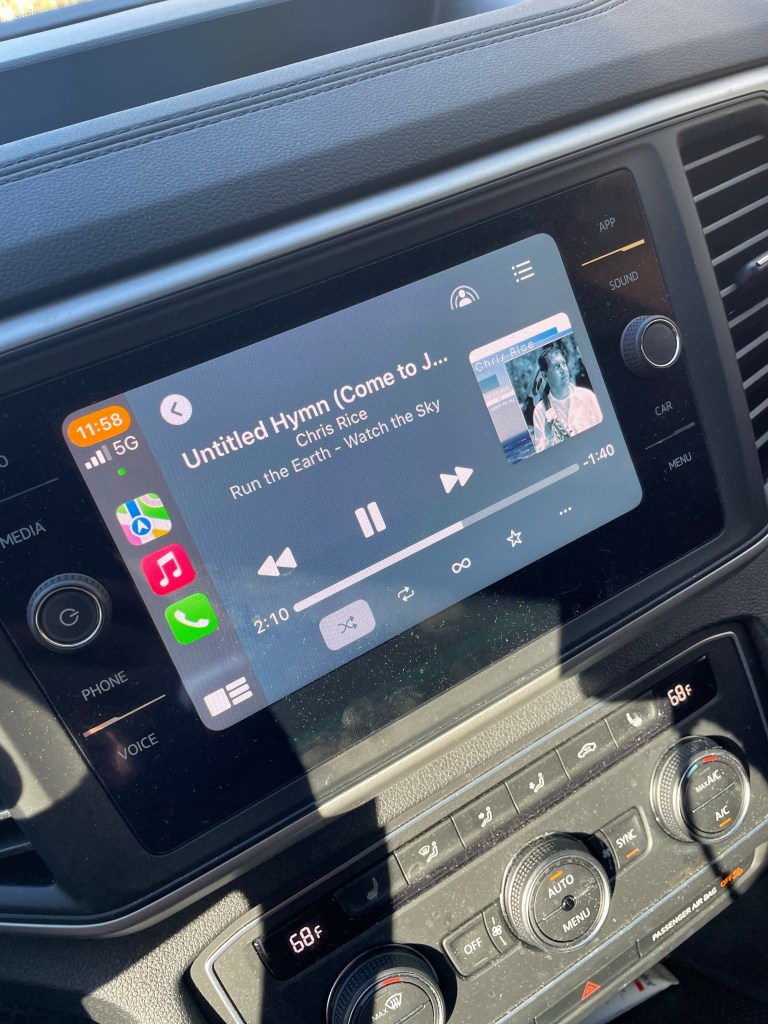
    Yesterday on my way to pick up Ella for her Christmas break, I thought about how my Dad used to make the long drives to get me at Emory. Halfway to Richmond with my whole music library on shuffle, Untitled Hymn (Come to Jesus) by Chris Rice came up. Although the song was already a few years old by then, I first heard it not long after my Papa died. I have never made it though the whole song without crying and this year I’ve hit next within a second every time it comes up. But yesterday, for the first time in a very long time, I listened. I sang all the way through and I did not cry.

    I did imagine my Dad laughing as I sang the last part. Perhaps the path to freedom is in keeping perspective: I may not have answers today, but I’ll one day laugh on Glory’s side. And with my Dad again.

    Sometimes the way is lonely

    And steel and filled with pain

    So if your sky is dark and pours the rain, then

    Cry to Jesus

    Cry to Jesus

    Cry to Jesus and live!

    O, and when the love spills over

    And music fills the night

    And when you can’t contain your joy inside, then

    Dance for Jesus

    Dance for Jesus

    Dance for Jesus and live!

    And with your final heartbeat

    Kiss the world goodbye

    Then go in peace, and laugh on Glory’s side, and

    Fly to Jesus

    Fly to Jesus

    Fly to Jesus and live!

  • Freedom Documentation

    Freedom Documentation

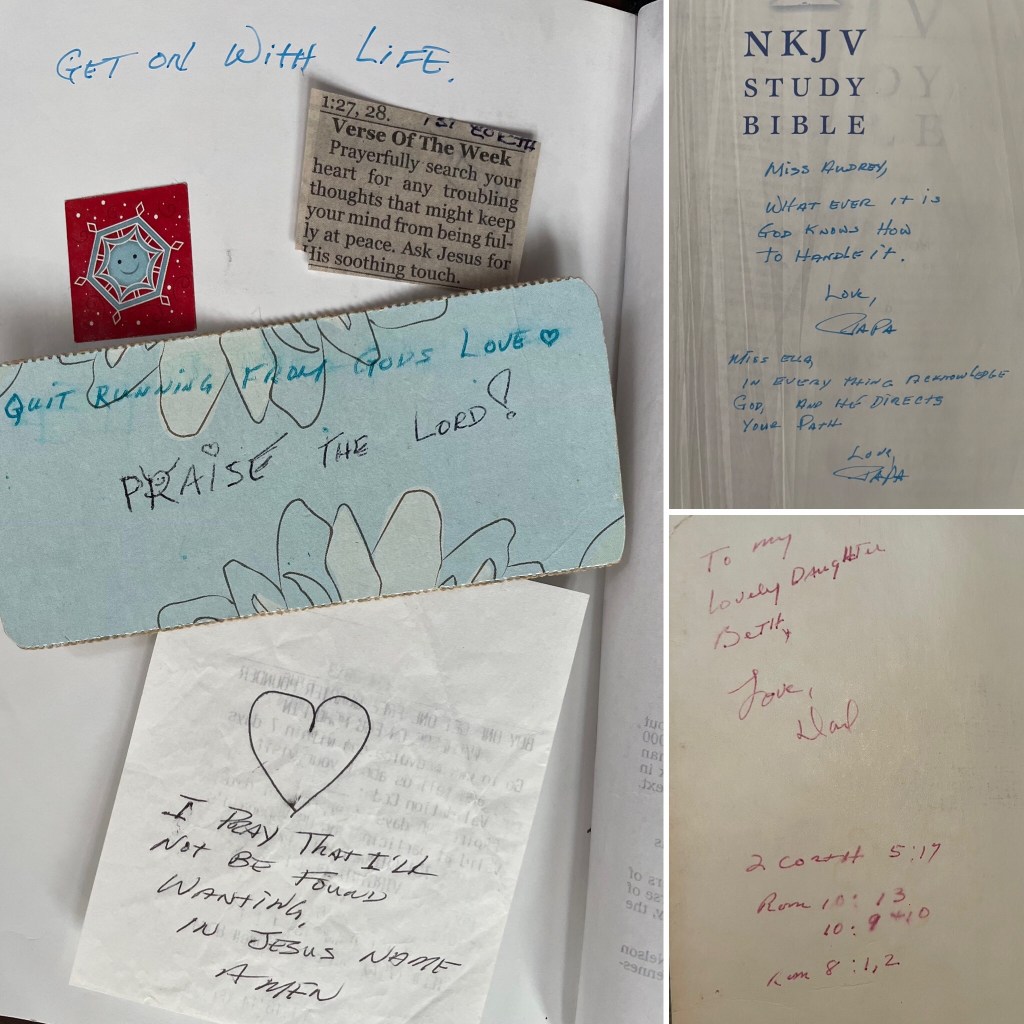
    One of my greatest treasures is dozens of little pieces of paper from my Dad. Cartoons he cut out from the newspaper. Thoughts he wrote down and stuck in my purse or laptop bag. Notes from sermons that he wanted to focus on and that he tucked into the bibles he eventually gave us. Little messages from him that I saved over the years and recently went back through as I mentally prepared for Father’s Day.

    A three-time Vietnam Vet’s commentary on my date’s attire: “Last time I saw someone wearing something like this I bushwhacked him in the jungle.”

    Some were funnies or just hearts expressing love and some were reminders that I could always, always come home. But most are lessons – lessons that are fundamental and yet have different meanings at each life stage and event. Lessons that grow with you, as you grow. I’ve started thinking about them as his constitution. The Constitution of Dad.

    Pray every day. Eeeeeeeevery day, he’d say, making sure I knew that the frequency is important. Pray Psalms 91. Pray the prayers in Ephesians. If you don’t know what to pray, just say the name of Jesus over and over. Praying allows God to work. And praying doesn’t change God’s mind, it changes ours.

    The longer you wait before making a u-turn, the more costly it is in every way. Sometimes we get on the wrong path. We’re certain it’s right until we know it’s not. It happens to literally everyone. And most importantly, it’s not a disaster. Even if it costs you money or you lose a little time to go back or hop over onto another path, this is money and time well spent.

    Let everyone be wrong. About you, about situations, about anything. Your peace is what’s most important and it’s your job to hold on to it. Good humans will admit when they are wrong and reach out to you. You need to admit when you’re wrong and reach out to people.

    Be honest, with everyone but most importantly with yourself. See things as they are and not as you want them to be or as you wish others would see them. If you cheat on that test, you did not earn an A or finish first – you behaved in a way to gain something. If you do something halfway, you deserve the C. Cheating and short-cutting will always hurt you more than anyone else.

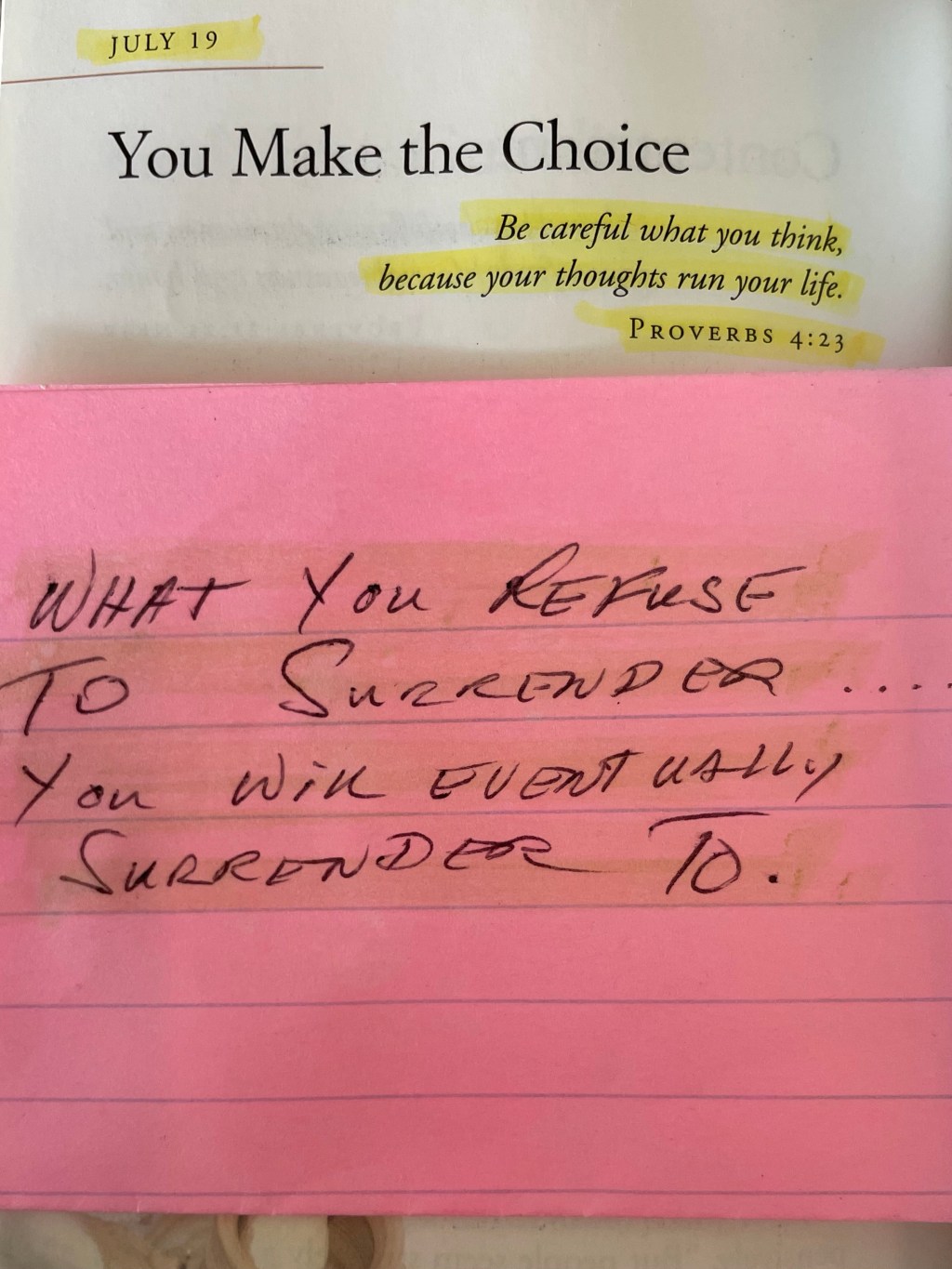
    What you refuse to surrender, you will eventually surrender to. Anger. Addiction. Unforgiveness. Fear. Insecurity. Expecting anything other than what God has promised.

    You gotta clean out your mind regularly. Think about what you are thinking about. Just like you tell your hand what to do, you tell your brain what to do. You choose what thoughts to keep and what thoughts to toss. About yourself and about others. If you allow your mind to focus on negative thoughts, you will feel and speak that way. And if you fill your mind with thoughts only about yourself, you won’t be of any use to anyone for anything – especially God.

    Do not limit God. With your words, your deeds or your thoughts. And our words have power, so always be mindful of what words come out of your mouth.

    Looking at his notes that most spoke to me, all spread out on my living room floor, I realized the common theme is they are paths to or instructions for living freely. There’s even a note on the inside cover of one of his bibles that says Get On With Life.

    Like Thomas Jefferson’s reference to our country’s living and breathing document to help guide a nation to “establish Justice, insure domestic Tranquility, provide for the common defense, promote the general Welfare, and secure the Blessings of Liberty to ourselves and our posterity,” the Constitution of Dad is my guide to living in freedom.

    My Dad and baby Ella. A girl Dad and a girl Papa.

  • Forward

    Forward

    If you remember anything about Robert Frost from your high school CliffsNotes, it’s likely some version of “the best way out is always through.” Maybe that’s true sometimes, but other times I think the way out may be to go back or even to be still. What I’ve come to believe is more true, particularly in navigating grief, is that the way through is forward.

    Forward.

    One step at a time. Left foot, right foot, left foot, right foot.

    The morning after my Dad died, I received a very clear message that the timing was on purpose. Tough days were ahead for my girls, and how I behaved would be what they looked to and what they remembered later. I needed to show them how to live and how to grieve – specifically how to do both at the same time.

    In the last 10 weeks, my girls have lost both their grandpas and their Dad. They’ve watched me cry and they’ve watched me laugh. They’ve watched me watch the same old episodes of Criminal Minds repeatedly, they’ve watched me do the crappy paperwork that comes with notifying companies that someone has passed away, and they’ve watched me excitedly buy all the shirts we even remotely liked at the VCU bookstore. They’ve watched me in funeral homes, shopping malls, church, the hospital, prom dress boutiques, long car rides late at night, and even doing my own yard work which they know I hate. They’ve watched me very purposely put time into projects where we could all see the progress and then the completion, and they’ve watched me take steps to plan things we can look forward to later in the summer and year. They have heard me pray for healing, peace, and knowledge of God’s presence in their lives and in the lives of people that I didn’t pray for for a very long time. And I am just not sure it was enough. Or that I showed them good balance in terms of moments of sadness and Easter basket hunting.

    I’ve been thinking a lot in the last few weeks about the word forward and how it relates to grief. What propels us forward, what stops us from moving forward, how best to move forward. Especially when life is unfair, or things are unfinished or unresolved. How will I help the girls move forward? What can I say? What can I do? How can I show them the way?

    I think maybe the key to forward is found in 3 other f words. (None of which is that f word.)

    Forgiveness. Forgive that they left, and believe they didn’t want to. Forgive yourself for relief they are not in pain anymore. Forgive them for old wounds you’ve been hanging on to. Forgive yourself for having mixed feelings about these people you grieve and love. Forgive that they weren’t perfect and forgive that you aren’t perfect.

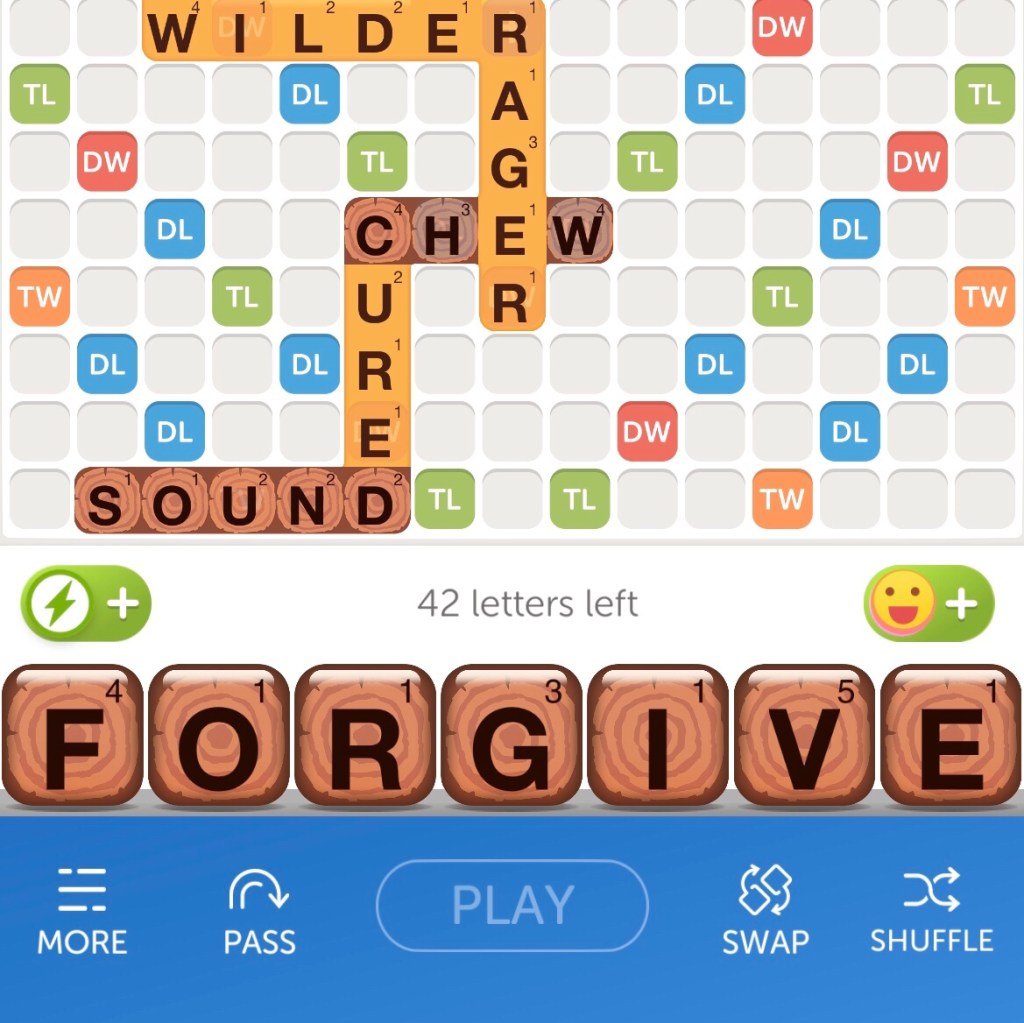
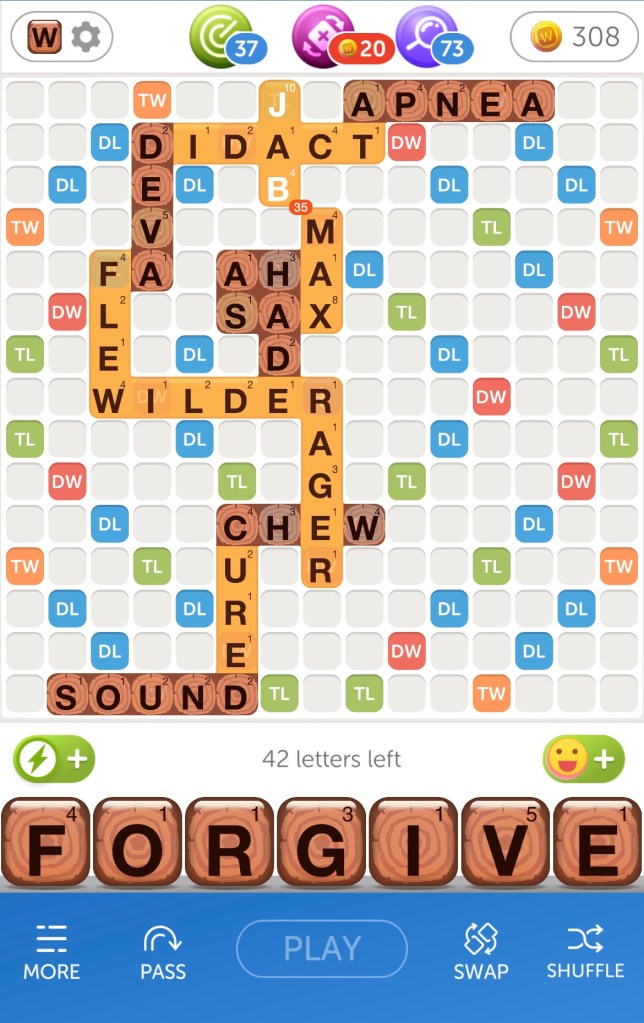
    When at first I will not listen, God will send a message through Words With Friends. Because I am stubborn.

    Freedom. We must give each other and ourselves freedom to grieve anywhere, freedom to grieve differently, and freedom from any timeline. We must also acknowledge that someone’s death brings them and us freedom, and that’s not something to feel badly about. They are free of all the yuck that comes with living in this realm and we are free to live without them here. The people who really love us, our people, delight in seeing us thrive – whether they exist here on earth or in our great cloud of witnesses.

    Faith. Holding on to your faith can be especially hard in this time but is especially important in this time. People will say things like God needed another angel. They mean well, but they are just wrong. (And if I find out this happened, the fourth F is Fite and I will make it stop.) God does not make people sick and God does not need more angels. You know who God is. It is deeply ingrained in you. HE is deeply ingrained in you. He grieves with you. And He promises in Matthew that those who mourn are blessed and will be comforted. Whenever you question this, and you will, it’s remembering His faithfulness at other times in your lives and in other areas of your lives that will give you peace.

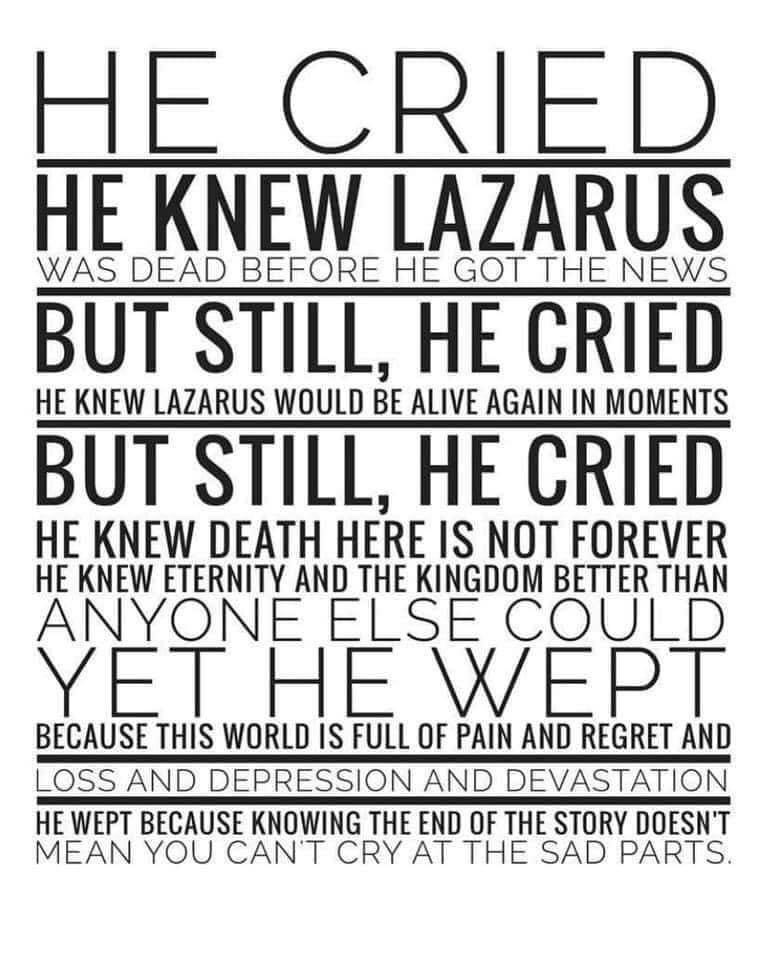
    He knew death here is not forever…He wept because knowing the end of the story doesn’t mean you can’t cry at the sad parts.

    I guess the simple truth – without steps and f words – is that the way forward is on a path of grace. Grace for ourselves, grace for those around us, grace for those who are gone.