Tag: grief

  • Dear Dad

    Dear Dad

    I’m tired. I’m guessing you know that, but I’m really not sure. Can you see me now, hear me? Do you know the things I’m talking to God about? In the last 6 days, I have thought more about what heaven is like than I did in all the 18,000 days prior to now combined.

    You’ve moved to a new place, and I’m not sure what it looks like. I have no pictures to help me visualize it, so basically I’m making it all up. It’s got a beach, mountains, fields of wildflowers, valleys with streams and wildlife, far east countryside, and even a middle of the ocean with no land in sight – and you can constantly move back and forth, and experience all the different kinds of land and sea scapes that brought you joy, and that you loved to just watch and feel and smell. Is that even remotely what it’s like? I doubt it, because according to Corinthians Things that no eye has seen, or ear heard, or mind imagined, are the things God has prepared for those who love him. I’m so happy to know without a shadow of a doubt that you’re in heaven, but it makes me sad not to be able to picture you somewhere.

    Now that you’re in heaven, assuming you see me, do you see me only as I am today or do you now have greater knowledge about all the things I said and did that little girls hide from their Daddies? Because YIKES if it’s the latter. I guess none of it would surprise you or change anything, but still – a girl should get to keep some secrets! Perhaps the thing I am the most thankful for right now is how many times you said to me “I am proud of you, Beth.” Sometimes you asked me to stop what I was doing and really listen to you say it, because you wanted me to hear it and absorb it. And I realized this week that I do really know it, and what a fantastic gift that is. As you would say, I know that I know that I know you’re proud of me – and that’s because you were a great Dad and you purposefully said it and made me pay attention. (I’m really hoping you didn’t say it so many times because you already knew about all the YIKES stuff and figured I might need extra convincing at some point.)

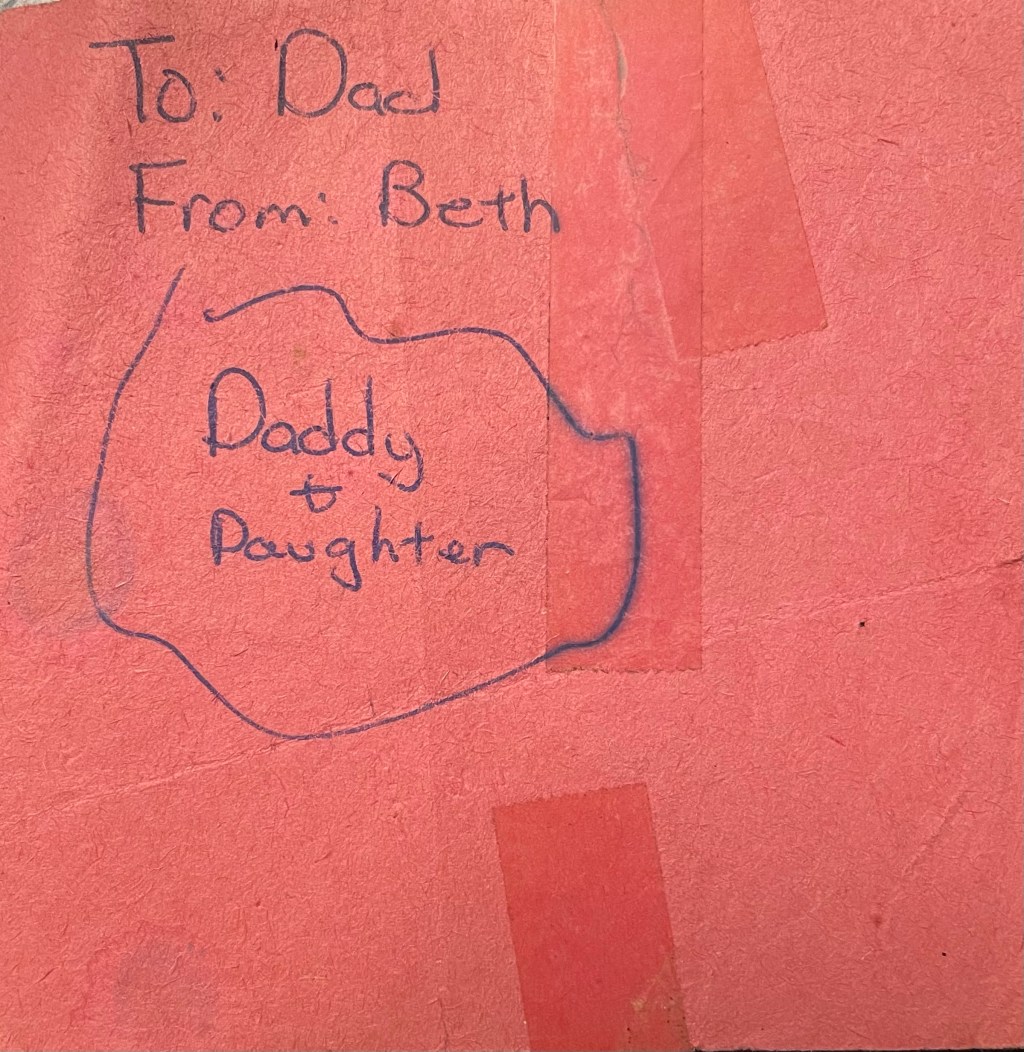
    I love that you kept this little piece of scrap paper for probably 40 years. I wish I knew or remembered the story of that day.

    Why did you die in the year of freedom? What’s the lesson for me there? I haven’t figured it out yet. I just don’t know now why my word for the year is freedom. Is Romans 8 a part of it? I have to think more on this.

    Message received, loud and clear, that this timing is by design. On purpose. God’s plan. How I live and behave and speak in these days is critical, showing others the way to grieve and to live. I’m doing my best. There has been some mild cursing.

    Sending us a police officer named Paul, who has parents named Paul and Linda, was the absolute best reassurance that God is with us, went before us, and we shouldn’t be discouraged.

    The day after you went to heaven, I ate the can of Campbell’s Chicken Noodle soup you always kept in the pantry for when anyone was feeling under-the-weather. You were so wrong to try to pass that mess off as some sort of Biblical cure because some Army guy from 1958 told you it was called Jewish Penicillin. It was salty, awful, zero stars and do not recommend.

    The song for this week was Van Halen’s Jump. I know you scowled every time I restarted it – but you have to admit that my awesome air drums were the perfect way to get my brain to shift from overwhelmed to focused, and to keep me from crying at stoplights. Rock and roll is not all sex and drugs and evil. I am right about Van Halen being talented, and since you’re not here to argue with me, I win.

    I spent time at Stumpy Lake this week thinking how you’d love all the sights and sounds out there, and looking for my eagle. I was frustrated not to see her. But then I realized she’s somewhere up there in the sky, even though I can’t see her. Just like Jesus. Just like you.

    While I was there yesterday, I Facetimed a friend and I was shocked to see myself for the first time. To find that the person staring back at me looked the same. The world feels so different, so I assumed I would look different.

    The world is full of pressure right now, from all sides. But I very clearly remember your instruction for when this happens:

    * Do not stop.

    * Keep pushing back and keep going.

    * An enemy knows when he’s losing. He will throw all he has at you in his last ditch effort, just before he surrenders.

    I was worried about Audrey’s dental work this week, because you weren’t here to pray. But Joy convinced me that your years of prayers for all of us keep working. I had no idea! Why didn’t we talk about this while you were here?

    I know it hasn’t looked like it at all moments, but I am OK. We talked about this time on numerous occasions and I am so thankful that you very intentionally spoke to me about it. I don’t always feel it, but I believe I am equipped because you said it. At the same time, I feel a little like I did when I realized that What to Expect When You’re Expecting in no way prepares you for having an actual baby.

    Miss and love you, Beth

    PS: It looks like Jimmy Carter is headed your way soon. You should maybe not tell him what you thought of his job performance and just focus on his post-Presidency work.

  • ETA Needed

    There’s actually a reward for being someone who focuses on self, and that’s that everyone around those types of folks expects very little of them.

    One of the greatest unfairnesses is that the people who hurt others are not the ones who handle the fallout or cleanup – they don’t ever see or experience the vast majority of the pain or of the healing process for those they hurt. The hard work, the help with recovery that takes days and weeks and months and years, is always done by others. It’s done by the consistent ones. The responsible ones. The ones who can.

    The privilege of being a helper comes with the burden of being a witness. If only you could promise those hurting a clear deadline for pain’s demise.

  • Grief and Growth

    Grief and Growth

    Grief, according to Psychology Today, is the acute pain that accompanies loss. I’ve always thought of grief as a period of time following an event, but the older I get, or perhaps the more life experiences I have, I realize that grief is actually a lifelong process. Grief is not something people feel or experience within a finite period of time. And it’s also not something that hits you only when you’re in a slump or already sad about something else. In fact the opposite is true, and it very often hits when you least expect it – at a time of happiness.

    My grandparents died many years ago now but occasionally one of the girls will do something and I’ll think things like Uncle Dale would just love that ornery-ness in Audrey or Mama would not like this music but she would be tickled pink to see Ella sing in church. Sometimes those thoughts make me smile and sometimes they bring tears to my eyes, and I think that’s because I’m still sad that they aren’t here with us.

    Grief is not just about mourning a person, but it’s also about mourning the loss of a thing – a job, a child’s favorite stuffed animal, a home when you move. And it can even be about unmet expectations, including expectations you may not have even known you had.

    Children have expectations about their life that grow and mature as they get older, as their world gets bigger, and as they reach milestones. A young person who never had parents may still mourn the absence of parents on a prom night or a wedding day or even a dark day like one of a diagnosis. A child who used to live with two parents may suddenly notice a traditional family at a restaurant or even on TV and then be overwhelmed with feelings such as I only have one parent here.

    I don’t think I believe in the old adage time heals all wounds. I think our wounds *can* heal with time, but when that happens it’s because we’ve used our time and energy to think about all that’s happened and we’ve bravely faced all we did or did not see, all the choices we made, or all that we could not control.

    For children this is especially tough because they really don’t control a lot that happens in their early life. And one of the complexities tied to their grief and their moving on from something is that it can seem like their ability to accept a situation is a validation of poor decisions others have made. What is simply an acceptance of the adult, and a willingness to love the adult anyway, can be a very large leap for wounded hearts to make.

    A child’s ability to move on with their life or accept a situation is also not the end of grief. The sad truth hidden within acceptance is that standards have changed. With acceptance, expectations are often lowered – of people, of life, and even of God.

    Acceptance is supposedly the last stage of grief, but I think maybe the stages don’t always go in order. Or maybe they happen in order initially but it’s not just one cycle. Because what’s clear to me is that there are still days and moments of anger or sadness long after the days of acceptance.

    One of the hardest things to do as a parent is to watch your child grieve. Tears, anger, tummy aches, sleeplessness and yet constant tiredness. Perhaps the next hardest thing is allowing your child to grieve in their own way and their own time, all while not adding your feelings to their burden, rushing them, or trying to save them from it.

    I came across an old word a while back: nepenthe. If I’d paid more attention during Shakespeare lessons I wouldn’t have had to look it up. It’s something that makes you forget grief or suffering. Alcohol, people, work. Even good things can become unhealthy addictions as we search for a nepenthe. I think maybe the bravest thing we can do when we’re grieving is to forego nepenthe. The bravest thing we can do is avoid all the things that could make us temporarily feel better and focus all our effort on working through our loss and our feelings.

    I found that Shakespeare even nicely summed up all the thoughts I’ve been trying to wrap my head around: Tears water our growth.

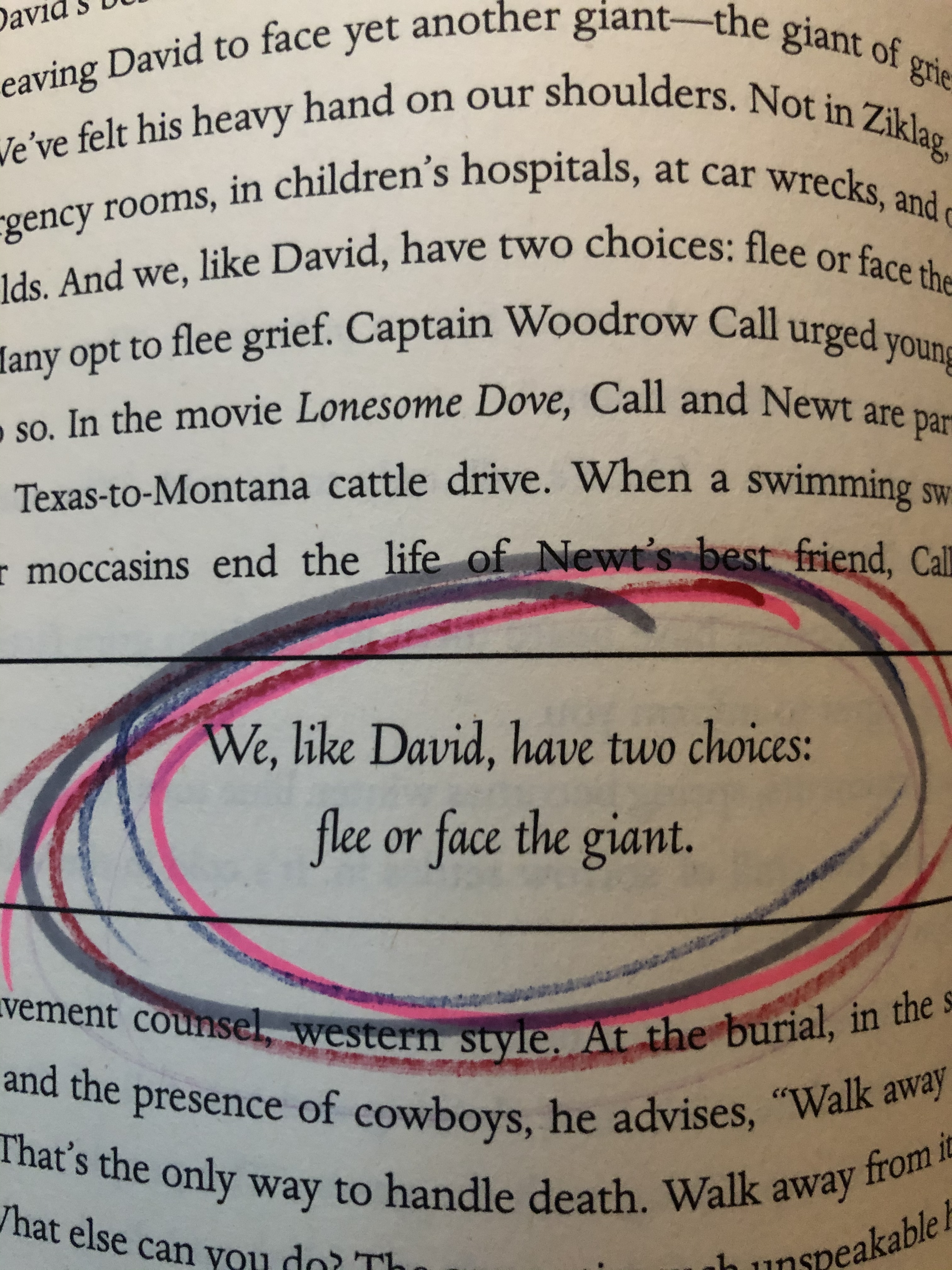
    Some time ago, I read Max Lucado’s Facing Your Giants. It’s about the life and choices of David, and about facing the giants in our lives. Grief is a giant. It often doesn’t reveal itself as obviously as Goliath did, so we have to be on the lookout. And when we recognize it, we have to bravely face it each time.

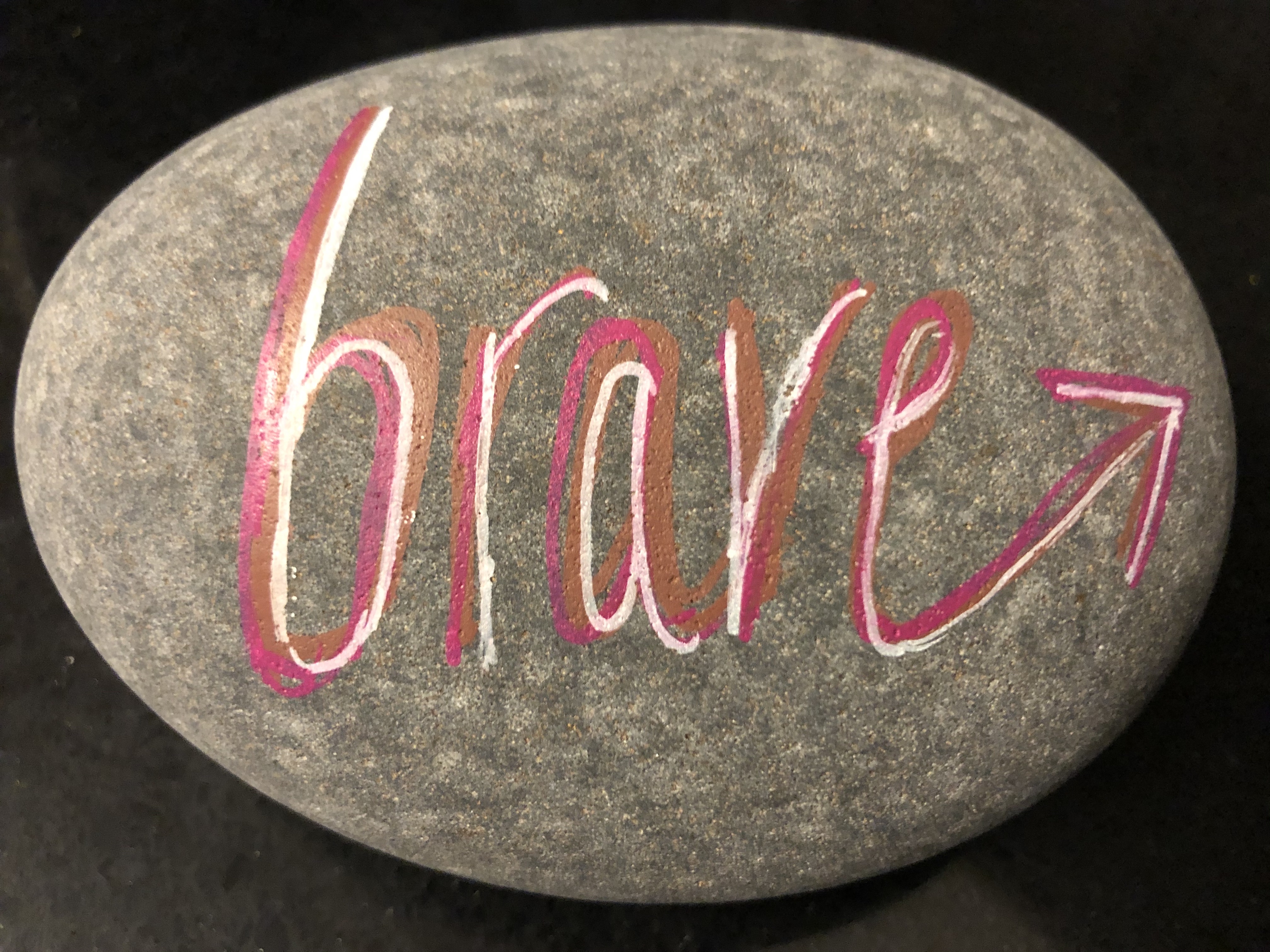
    Last week at a work event, our leadership team painted stones with messages that are important to us. I used three colors to write the word brave – a color for me and each of my girls. Brave is my battle cry and my encouragement. It’s also my reminder that David defeated Goliath with just a small smooth stone.

  • Grieving is Brave

    Grieving is Brave

    It’s hard to predict what things will “stick” in our children’s minds years from now. What memories will become indelibly lodged in their brains and psyches. What events will be life changing. What words will be mulled over repeatedly. What action or inaction will never be forgotten, and will alter the way they think and behave forever.

    Will my girls remember the words I carefully wrote and practiced on the topic of not caring about what other kids think? Or will they remember that I shouted and took their phone away when they didn’t come home on time? Will they remember me saying you can do it, you just haven’t done it yet? Or will they remember me crying about my failed cooking attempt at the end of a very long day?

    Parenting is a such a huge responsibility. In fact, it’s absolutely terrifying if you really stop and think about it. Our behavior is one of the primary things responsible for how our children’s lives will play out. They have free will and so will, of course, make some choices as adults that we would not (which in some cases could be a very good thing!). But the way we speak to them becomes a voice they hear in their head throughout the lives. The way we handle adversity in their lives and our lives becomes a lesson they will refer to time and time again. The way we choose happiness, the way we choose avoidance, the way we live with or without moral principles, the way we embrace faith or fear, the way we prioritize – they all teach our children something, even and especially when we’re not actively thinking about our choices.

    Almost 4 years ago now, our beloved cat Sammy passed away. It was a chaotic weekend of visits to an emergency vet without all her normal paperwork, which led to concerns she was not up to date on her shots even though I knew she was, which ultimately ended with animal control keeping her body for rabies testing. We didn’t have Sammy’s body to bury, but I thought that the girls having the ability to say goodbye before she died and our talking about seeing her again one day in heaven were all things that would help them through the grief process. What I didn’t realize then, that I’m keenly aware of now, is that (1) the grief process is unique to every person and (2) the notion that grief is a 5-step process is a load of doodoo. Grief does not have a finite end, which is the implication of a process that ends with something called Acceptance. And in fact I think grief is likely a lifelong experience.

    Our lives are all filled with ups and downs. With happiness and with disappointments. With change. Our lives will inevitably involve the death of loved ones and the death of people we didn’t know but who moved us in some way. Our lives may include the loss of a job whether by our own choice or someone else’s, perhaps the loss of a pet, a marriage, a feeling of safety, an innocence, a fall from grace, an expectation of what life should have been like. Grief is just a part of life.

    We will grieve all of those losses and while we will hopefully move past the initial intense feelings associated with our grief, we will remember the loss or change throughout the rest of our lives. We will remember the circumstances and we will remember our pain, and we will remember the way others reacted and grieved. And something as simple as a song or scent or photo will bring it all back in a flash food of emotions.

    So the things that become really important as it relates to grief are that for a time we commit ourselves fully to it instead of avoiding any part of it, and then we don’t allow ourselves to wallow in it forever. We have to purposely pursue healthy grief – so that when we are faced with those inevitable flash floods of emotions that will come days, months and years later, we are able to navigate those waters.

    Each loss in our lives, even if it’s a loss that’s different from others, can remind us of any and all other losses. The suddenness and unexpectedness of a family pet’s death parallels the suddenness and unexpectedness of our family changes. And so the loss of Sammy in 2015, which I didn’t handle with as much thoughtfulness as I should have, is now something we are thinking about and experiencing again. I didn’t think twice about not having her body to bury or cremate because I didn’t need that to grieve, but others missed it because they grieve differently.

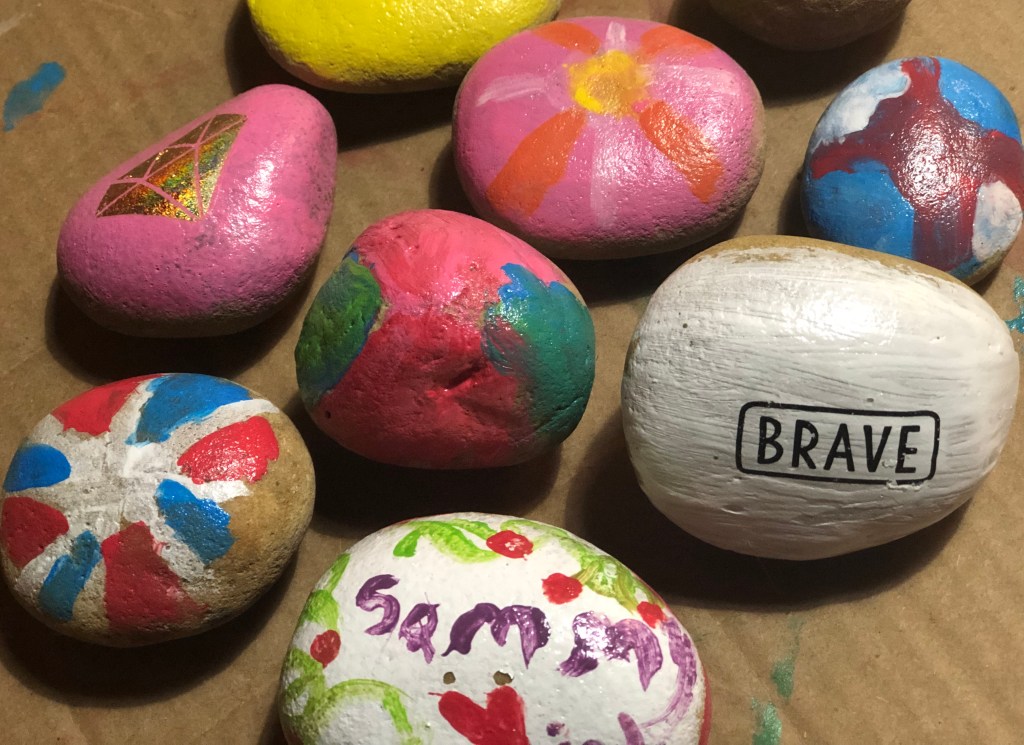
    Sammy was a contradiction in many ways – a loner who liked her space and yet loved to take naps on my chest, a kitty who loved play in her younger years but embraced a bit of laziness as she aged, fiercely protective and purry and lovey and a bit cantankerous all on the same day. We honored her this weekend by talking about her and looking at her pictures, and at Audrey’s suggestion, we painted and decorated rocks for our yard to honor her and remember her.

    We grieved purposefully. We grieved bravely.

    Will the girls remember our stones for Sammy? Stones painted on a cold day when the sky was crying big raindrops? Or will they instead remember the smell of my overcooked crockpot orange chicken? Perhaps they will not actively remember anything about this day at all, but carry within them a sense of peace because we took time to acknowledge that Sammy will be a part of their lives forever.

    “You will lose someone you can’t live without, and your heart will be badly broken, and the bad news is that you never completely get over the loss of your beloved. But this is also the good news. They live forever in your broken heart that doesn’t seal back up. And you come through. It’s like having a broken leg that never heals perfectly – that still hurts when the weather gets cold, but you learn to dance with the limp.” ~ Anne Lamott