Somehow the teenage years are here and I feel woefully unprepared. Woefully unprepared to navigate all that these years come with. Woefully unprepared to help her navigate all that these years come with.
I realize this child lives in my home and I have planned a birthday celebration for her every year for the last *almost* 14 years. And so it seems like I’ve had ample time to prepare for her to be in relationships of her own, but this responsibility has really snuck up on me. If I’d thought about it carefully in advance, I might have prepared one long talk about how to behave and how others should behave, but I didn’t think of it in time – I didn’t think of it before I was in the middle of what I realized after-the-fact was actually one of many quick conversations about things that are really, really important. Things that need time to be discussed. Things that need to percolate, in my brain prior and in hers after.
Because how your child treats people and how people should treat them is actually just a pretty small part of what you have to cover. I’d forgotten in the thirty-ish years since I was a teenager how much of our growth and learning actually comes by watching and “experiencing” the stuff that happens to and with our friends. Remember how it felt to be 13, 14, 15, 16 when everything that happened to your friends, whether it was good or bad or happy or sad, was soooo big and it felt like it was also happening to you even though it was sometimes just happening to one of your friends? It’s like we all group-experience a few years of our life.
While kids are in elementary school, parents have the luxury of knowing most, if not all, of the kids their children are spending ample time with. But that changes as they get get older and suddenly you’re answering questions that really aren’t about what’s happening to your child, but about what might be happening to Tiffany from Spanish class.
- The first challenge is that you have no context – you know nothing about Tiffany’s life, her parents, her friends, anything.
- The second challenge is that even though something may be happening with Tiffany, young people feel the things happening to their friends really deeply and they don’t always separate themselves from it.
- The third challenge is that your child may never have had an experience like Tiffany’s but this is her first exposure to whatever it is and so she is going to learn a lot from it one way or another – so helping her process exactly what might be happening and why is important because it will shape her future relationships and her unconscious bias for possibly the remainder of her life.
- And the fourth challenge is that as a parent you are always missing part of the story because your child, who is learning, is missing large details when they tell you things – things that adults would ask or focus on, but she doesn’t even know are important yet.
THIS. IS. SO. HARD.
And you know what happens as you are mulling over your advice and wondering if you covered all you should have and you’re realizing all the other things you should have said or asked or focused on? You find yourself suddenly terrified that Tiffany doesn’t really exist, and this might actually be your child that had the question but they’re afraid to tell you.
THIS. IS. SO. HARD.
I now need so much more than the old “Don’t forget who you are and whose you are.” I need to cover so much more than the typical sex and drugs and alcohol talks we all give our kids.
I’ve been keeping a mental list and an actual list in my phone. Multiple lists actually. A list of things we’ve talked about and a list of things to talk about and a list of things I need to go back and touch base on when the time is right. If I could just get out my phone and review my lists when it’s time to have these talks, things would be so much simpler.
My lists may seem neurotic but one of the benefits to seeing what you’ve “written” down over time is that there are almost always a handful of bigger common themes. I don’t think my teenager is going to sit through a list of 37 things to remember while she and her friends are navigating first relationships. But maybe I can get her through a top 5…
YOU ARE WORTHY. You are worthy just because. Because you’re human. You are likable and loveable, but you are not and will not ever be liked by everybody. It’s OK that some people aren’t your thing and that you aren’t their thing. That has nothing to do with your worth and value, and everything to do with the fact that we weren’t made to all like each other. We need to coexist peacefully – in middle school and all around the earth – and that happens when we understand that all people have worth, and we should treat them with respect as we want to be treated.
DON’T LOSE YOU. You are whole all by yourself. You are not ever a half. You may be introduced in relation to someone to provide context, but you are not someone in relation to another person – who you are is not Tiffany’s friend or Thomas’ girlfriend. You have dreams and goals, and anyone you’re with should have their own dreams and goals. When you find someone who truly cares about you and who you truly care about, in friendships or romantic relationships, you will cheer each other on as you work toward all of those dreams and goals. Some relationships and friendships will end, and when they do your whole self keeps journeying forward because you have held on to the truth that you are not half.
BE YOU, NOT SOMEONE ELSE. Be authentic. Feel how you’re feeling, speak truthfully, like things you like and don’t like things you don’t. Don’t act or be or feel a way for others. When you like someone who doesn’t like you back, trying to make yourself likeable to them is a trap. That’s called acting, and if you start to act like someone else you will have to keep acting to maintain that relationship. Acting will always result in a final scene. You need to find your people, the people who you love and who love you, when you are your real self. Everybody’s real self is a little all over the place sometimes, so don’t expect consistency. Your people will always love you, even and especially on the days when you haven’t washed your hair and you’ve been a total crappy-pants.
CHOOSE YOUR GIRLS. Choose who your girls are wisely, and then choose them every time. You are all imperfect, but you stick together. A group of girls will make each other happy and mad and sad, and they will cry and shout because of each other. Even so, when you go out together you are a unit and you are responsible for one another – you all make sure the others are safe and not forgetting who they are. Be very careful about choosing a boy over your girls – you probably shouldn’t have some one(s) around you if you feel you’re in a situation demanding that. Your girls will be your girls throughout many romantic relationships and life-stage friendships. When one of you is mistreated, and this will happen, believe her. Believe her.
BE ACCOUNTABLE. The way you behave is 100 percent about you. The way others behave is 100 percent about them. You are responsible for how you behave and you will make mistakes. When you behave badly or make a poor choice, there are consequences and you have to suffer through those. When you mistreat someone, you need to own that. However, you also need to fully understand what is not your part. You live in a world of girls and boys and men and women who sometimes try to make females responsible for things they are not, and you need to be aware when that bias and manipulation are in action. The way you dress is never the reason someone touches. Something you did or didn’t do is never the reason someone hits. Something you did or didn’t do is never the reason someone cheats. When people blame-shift or victim-blame, recognize it for what it is and call it out. Any female who victim-blames other girls should not be in your group of girls.
Are those 5 really enough? I didn’t even say have fun (but not too much fun). Or, you have decades of adulting ahead so just embrace this time of learning. And x behavior is unhealthy but y behavior is OK. Don’t let your feelings or your fears override logic. You won’t like who you are if you allow yourself to sacrifice your values for your feelings. And you need to recognize the differences between first loves and for-now loves and forever loves. And it goes on and on and on. And suddenly my original list of 37 things is getting even bigger.
Parenting sometimes feels like I’m tripping up stair after stair, just righting myself from not properly landing on one step while having to take the next step. The only step on which I know my feet are both firmly planted on this topic is this one: If you know who you are and stay true to that, you will be just fine.
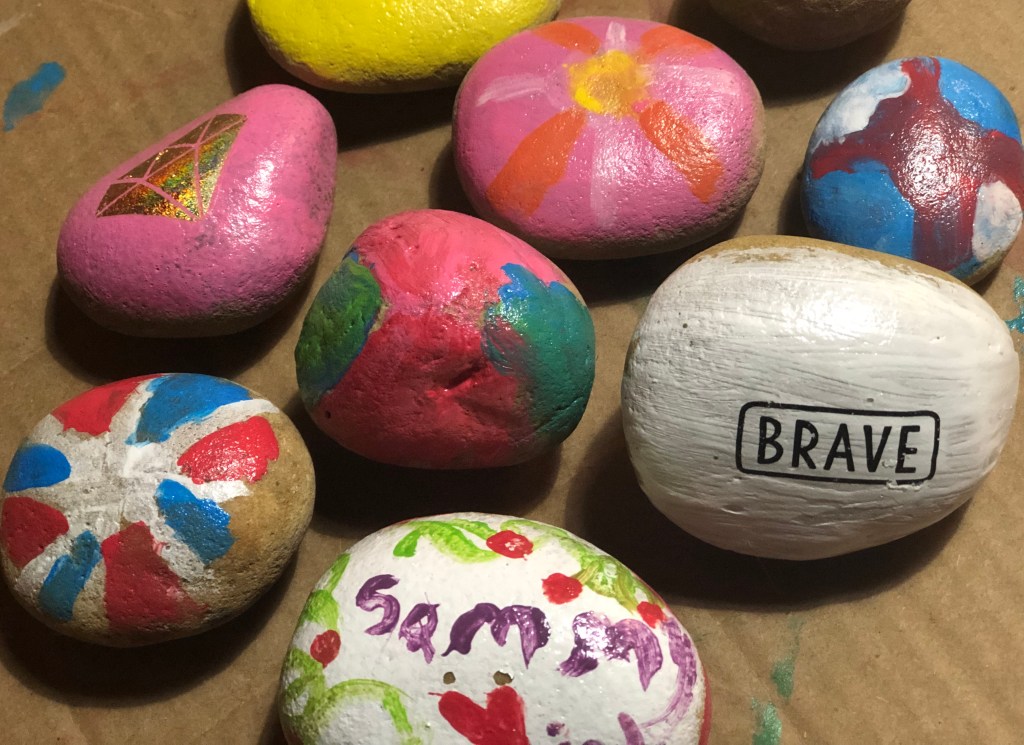
Know who you are, brave girl.
You. Are. Beloved.