Tag: truth

  • Help Me To See

    Help Me To See

    For the last couple of weeks, I’ve been focused on this mantra: God, help me to see what you want me to see. A speaker at a retreat I attended shared that she’s been starting her day that way, and it stuck with me.

    God, help me to see what you want me to see.

    We see and process thousands of images each day. Tens of thousands. Our brains process what we see in milliseconds, and then do things like tell our eyes what to look at next or create a smile in response to joy.

    Everything we see communicates something to us. We may need to see more in something or we may need to see (or “read”) less into something, but everything we see has a message. And as we interact with people throughout the day, I think the vast majority of what we see is based on choices – our choices, the choices of others, and our reaction to the choices of others. Our brains process, we make judgements based on, and we have reactions to or feelings about things like what someone chose to wear, what attitude someone chose to have, or what action someone chose to take or not take.

    What we see in ourselves and in others is a lot about choices. And the more I purposely focus on God help me to see what you want me to see the more the word “you” becomes important. God help me to see what YOU want me to see.

    About 18 months ago, I journaled about choices:

    * We are all a product of our choices.

    * Our choices reveal who we are.

    * Our choices reveal our priorities.

    * Choices that are easy moment to moment often end up being costly.

    * Everything in our lives is a reflection of our choices. What we are or are not is a reflection of our choices.

    * If you’re an adult, you make and made your own choices. No one but you is responsible for the life you’re living. One of the many choices throughout any given day is to turn around or not, to restart on a new path, or be lazy, or continue on a path of bad choices.

    * If you have children, literally every choice you make impacts them somehow.

    * Loyalty is a choice. Integrity is a choice. Love is a choice. Hate is a choice. Forgiveness, Honesty, Courage, Vengeance, Bitterness, Presence, Busyness, Learning, Happiness, Faith, Patience are all choices.

    * Your reactions to the behavior of others are choices.

    * Not making a choice or letting others choose for you are choices.

    * Your background and experiences shaped who you are, but where you are or are not in life goes back to your choices. You are not a victim of the choices of others unless you choose to be, but you are simply the product of your own choices.

    * You have the freedom to choose anything and everything, with the exception of the consequences of your choices.

    I went looking for that entry a couple days ago and have reread it several times trying to decide if the list is complete. It’s not, and this is what’s missing: choices are the primary thing we see in people.

    No words I speak ever communicate as clearly or as loudly as the choices I make. No words we speak ever communicate as clearly or as loudly as the choices people see us make. No art we create and no words we write tell the story of who we are like the choices people see us make. What conveys the truth about what we actually believe in are the choices we make. What conveys who and what is actually the priority in our lives are the choices people see us make. No one has more influence over the message of who we are than we do, and that’s because the only person responsible for our choices is us.

    Choice is our most powerful communication tool. Our choices are greater than any spoken or written I love you. Our choices are the proof.

    And the reality that choice is our most powerful communication tool is even more significant for parents. Children often don’t understand our grown-up words, so all they have to go on is the choices they see us make. And as children get a little older they don’t believe the words we say because they don’t want to listen to anyone or even because we’ve let them down before, so they look at the choices they see us make. We have to constantly assess what our choices are showing them. That’s when God help me to see what you want me to see becomes God help me to see what my children see in me.

    God help me to see what you want me to see. Help me to see what you want me to see in me. Help me to see what you want me to see in others. Help me to see what I’m communicating with each choice I make. Help me to see.
  • Don’t Hide Half, Brave Girl

    Don’t Hide Half, Brave Girl

    One of the fastest ways to make me angry is to tell me half. “My room is clean now” sounds great, but it’s really only half if you’ve shoved a bunch of candy wrappers under the bed. “She hit me” is only half if she was pinched first. “This car would be cheaper than the one you have now” is only half if the new car comes with no warranty and requires more expensive gas.

    Just tell me the truth already. Because half is not truth. Truth is always whole.

    I’ve been thinking a lot about happiness lately. What makes people happy, does everyone have a right to be happy, is it wrong to be happy when people we love are not, is it weird to be happy when your life has a big problem in it? Is hope the key to happiness? Or faith? Love? Xanax?

    I’ve decided that people who say happiness is a choice are right, but they are really only telling you half. The key to happiness is not in any choice in something external – it’s not in love, not in the achievement of a goal, not in a person, and not even in a faith of some sort. Anyone can choose a mate or a puppy or a bottle or a cause or a church. But none of these things, these choices, will ever be enough to get you to happy. And that’s because the real key to happiness, I am convinced, is 100 percent internal – it’s in learning to like yourself, it’s in living in a way such that you can like yourself, and then in simply owning who you are.

    If we are honest with ourselves about who we are, and if we like ourselves when we’re alone with ourselves, we can be happy. And if we can be ourselves no matter who’s around and no matter where we are, we can be happy. But if who we are is different based on who we’re around, one of two things is true: either we don’t know who we are yet, or we are well aware of who we are and we don’t want others to see that person. It’s when we speak half or live half – only showing a part of ourselves in hopes others will like us – that prevents us from being wholly happy.

    We must stop living half. And we must stop half-telling our story.

    If we tell people we need forgiveness for hurting others because we struggle with an addiction or a disease, but in private we don’t seek professional help to help ourselves…we’re telling half.

    If we only show people the pictures where our hair is in place and our house is clean…that’s half.

    The thing about our halves is that we may be hiding them from others, but we’re not hiding them from ourselves. We know we’re showing half – and if we’re at all good people, we can’t really get to happy by showing half. The halves that we hide because we’re ashamed of them or because we think they make us the most unworthy or the most bad will actually lose their power over us when we own them. It’s in our transparency, in our ability to reject the urge to only show half, that we find the freedom to be happy.

    Real humans have a whole story, and in every one of those stories the human is imperfect and/or their life has something wrong with it.

    This weekend I watched a group of young people tell my seven year old they missed her at an event a while back. Her face fell and her entire countenance changed. Her confidence was gone in an instant, and that’s because she remembered why we missed it – she doesn’t have a traditional family anymore and that’s been a very tough reality for her to accept. And just as I was about to smooth things over, she blurted out that her Dad doesn’t live with us anymore and he has a different life. I could not have been more proud that she spoke a truth that hurts her deeply. And two seconds later my heart burst with gratitude as I watched a teenager reply, “Yeah, my Dad, too. But I’m still gonna be a doctor. What are you going to be?”

    I realized in that moment – the moment where I almost spoke half to smooth things over, which would have cheated my daughter of a wonderful moment – that not only does our transparency about our whole self and our whole life allow us to free ourselves of a bondage, it also allows us to see that others are like us. If we don’t share our whole selves we can’t possibly feel the grace and love others have to offer us. If we live and speak only half, we’re essentially cheating ourselves of our ability to heal.

    I’m determined not to live and speak half – not just because I’m not smart enough to keep up with all the omissions, but because I want to spend my life doing stuff other than hiding and pretending.

    So…I go to church and yet I sometimes drop F bombs (especially when in traffic). I’m a Mom who doesn’t like to cook and I’m a Mom who embraces restaurants. I will not hide that from bus stop Moms who are good cooks. I’m a Christian who has gotten so angry that I have shouted that I hate people and that I can’t wait to attend their funerals. When my pastor asked how I was doing later that day and I said “fine,” that was half. Because while I am actually a good bit more than fine at this point, there’s still a shameful, angry truth – a half – that I hide.

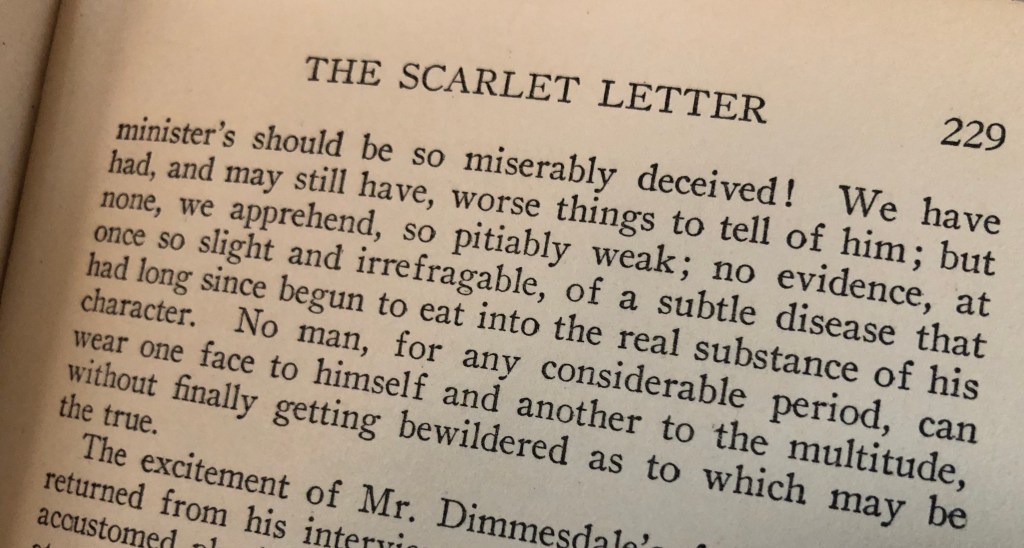
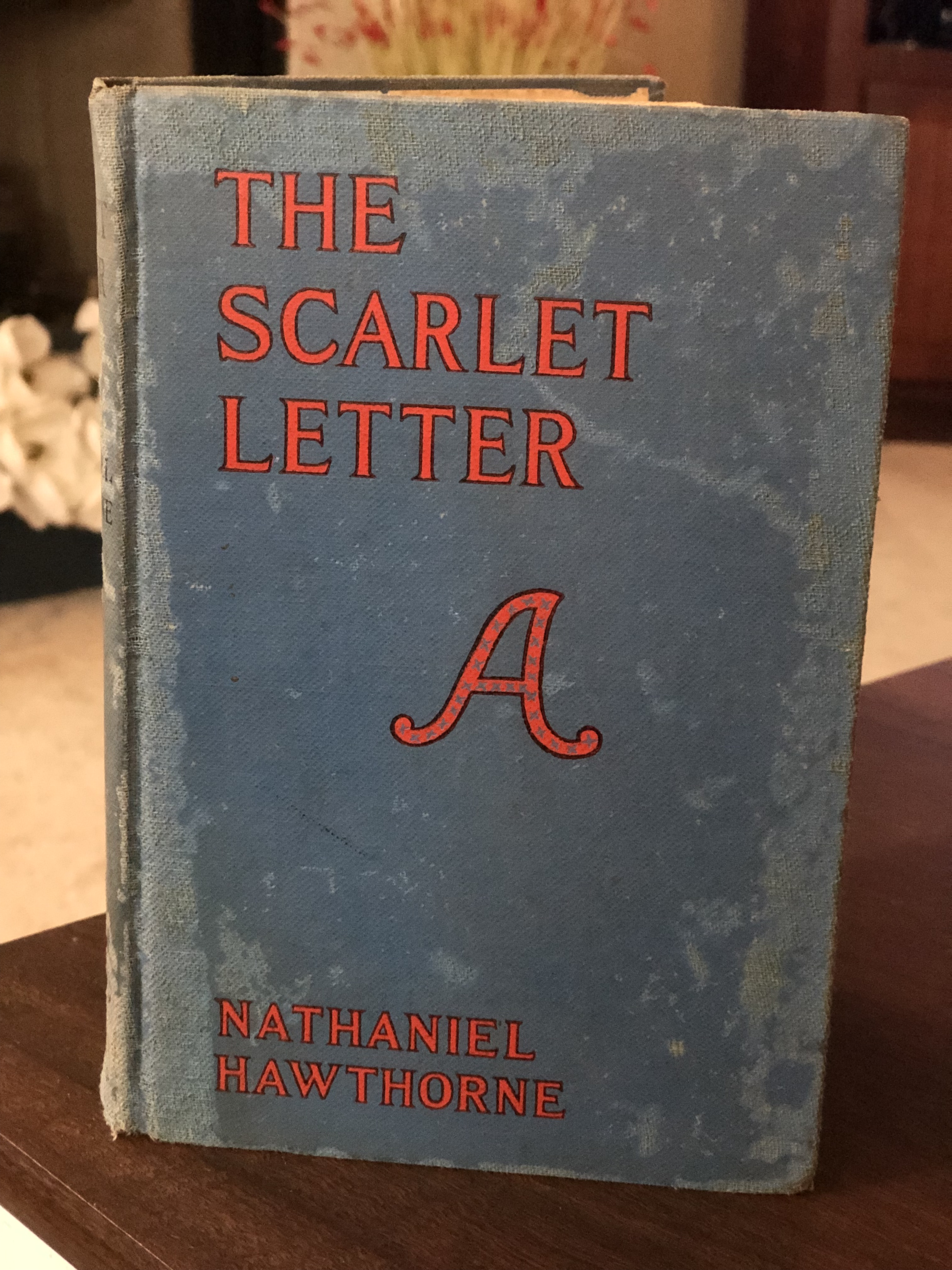
    A few months ago, I was wandering around an antique store and I came across a couple shelves of old books. To my surprise and complete delight, I found an old copy of one of my favorite books: The Scarlet Letter. I read it the first time in high school, loving the story but thinking it was outdated and didn’t really apply to life now. That was more than 25 years ago, and I’ve found The Scarlet Letter speaks to me today more than ever. While I’d love to see some people have to wear a scarlet A upon their chest, that wouldn’t send a message most people around them don’t already suspect. The timeless message is this: “No man, for any considerable period, can wear one face to himself and another to the multitude, without finally getting bewildered as to which may be the true.”

    I’m not bewildered about who I am. I know I’m a person who doesn’t really wish harm on others and that loves people and that does her best to live the right way and that is a Christian…but still, that’s just half. I’m a Christian who has a heart that has hate and anger in it, and that’s not a half of which I’m proud.

    But you know what? That’s my whole.

  • Alice in Wonderland

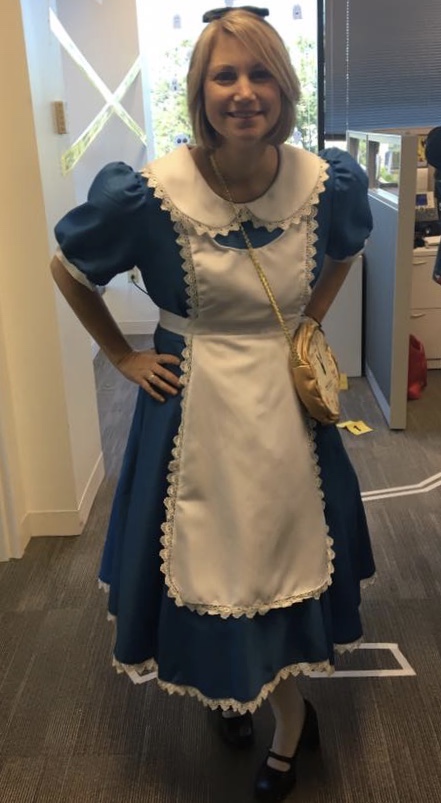
    My first glimpse of truth was at a costume party. He took me to her house for the event, and the two of them enjoyed shots with neighbors and work pals while her husband and I watched them like they were our errant children, laughing about how they couldn’t hold their liquor and wouldn’t make it through the whole party. I’d planned to go as Poppy, the happy-go-lucky girl from the movie Trolls, but at the last minute decided instead to wear a costume I’d purchased for an office event. I was Alice, from Alice in Wonderland, in a big blue dress, properly pressed apron, and a little purse that looked like a clock.

    There are dozens of theories about what all the fantasy in Alice in Wonderland really means, but I think almost everyone would agree that at least in some way it’s a story about the loss of innocence. And at the center of that story is innocent Alice – polite, sometimes snarky, trusting, with a little bit of a temper. One of the many supporting roles in Alice’s story is The White Rabbit, the character that leads her deep into a rabbit hole to a fantasy land. The White Rabbit is the character that leads Alice to awareness. The White Rabbit is the character that leads Alice to truth.

    Some would say that The White Rabbit is a counter for Alice. The initial persona of a happy, carefree character fades and The White Rabbit’s overwrought and desperate self becomes visible. The neurotic character is a counter to Alice’s calm. Lack of composure counters her purpose. Alice is curious about The White Rabbit, and as Alice says, “curiosity often leads to trouble.”

    Watch: The Rabbit Hole

    The party was filled with happy people, all dressed up for fun. Neighbors and friends dressed as doctors and clowns and such. He was Batman – the costume of a character that lives two lives, who lost the most important people to him in his childhood and who fights to help others not suffer the same loss of family.

    One of the funniest details in this wonderland/party story is that two people who hadn’t spoken to each other about costumes before that event were both dressed as characters from Alice in Wonderland. Me as Alice, with my proper white tights and Mary Janes. Her as an adult steampunky version of The White Rabbit, with bunny ears, leather short-shorts, and black fishnet stockings. It was so funny that people took our picture together – two characters from the same story, a contrast of light and dark. There might actually be more irony in our choice of costumes for that night than in all of Lewis Carroll’s writing.

    Did The White Rabbit invite Alice into the rabbit hole and to the party in hopes Alice would see some truth? Perhaps to force the hand of all the players in wonderland? There’s no question what the outcome would be once everyone was exposed to truth. Or did The White Rabbit invite Alice into the rabbit hole and to the party because games were just part of the fun and thrill? In the big scheme of things, The White Rabbit’s motives are not important. The more important question was why Batman would take Alice to The White Rabbit’s house for a party.

    I used was because it doesn’t matter anymore. I don’t care why people behaved the way they did, and even more than that I don’t believe in coincidences. I believe in divine intervention. Sometimes the seemingly awful things that happen to us end up being our salvation from things that will really harm us. And there are messages and lessons for us not just in what happened, but also in our surroundings at and in the details of those events.

    Here’s the thing about Alice and The White Rabbit. In the end, after all the chaos and confusion, The White Rabbit is just a noisy trumpeter that’s a slave to others in a world of fantasy. But Alice…Alice separates herself and she runs away from all the dysfunction. Alice looks at that screaming mob that’s yelling at her and railing at her, and Alice focuses on the calm guidance of a doorway to peace – and then she wakes herself up.

    Watch: Alice Wakes Herself Up

    I threw away my Alice costume long ago. I didn’t want the reminder of such a horrible night hanging in my house. I regret that. I likely would never have worn it again, but that Alice costume is a symbol of so much more. It’s a reminder that Alice knows what is real and what is not. It’s a reminder that Alice chose peace over chaos. It’s a reminder that Alice saved herself.

    Alice saved herself.